Mostrando entradas con la etiqueta Santa Teresa hotels. Mostrar todas las entradas

lunes, 8 de junio de 2015

The swimming pool in the ocean at Santa Teresa Costa Rica

Playa Hermosa Costa Rica tidepool

I slipped from the rocks into the cool placid water, refreshing even at 7:00 a.m. compared to the heat and humidity beginning to rise from the beach and rainforest. I couldn’t believe how clear and still the water was, especially when big, frothing waves pounded only a dozen or so yards away.

I was swimming in the giant tide pool between Santa Teresa Beach and Hermosa Beach – better known as “Playa Hermosa” – on Costa Rica’s southern Nicoya Peninsula. The larger-than-Olympic-sized shallow sea water swimming pool is one of the best-kept secrets of the area.

Playa Hermosa Costa Rica tidepool

Since Santa Teresa and Playa Hermosa – listed by TripAdvisor as Top 10 Beaches in Central America and Top 10 Beaches in Costa Rica for 2015 – are better known for being some of the best surfing beaches in Costa Rica, the tide pool often gets over-looked for great waves. Also, you can only find the tide pool at low tide, when the long, flat beach widens immensely. It is located between Pranamar Oceanfront Villas & Yoga Retreat and “El Peñón,” or the big rock, where Santa Teresa Beach turns into Playa Hermosa.

The sun-warmed clear water ranges from knee-deep to about chest-deep and is filled with all kinds of interesting sea creatures that get trapped when the tide goes out. You can find sea anemones, sea stars, crabs, mussels, hermit crabs and lots of little brightly colored fish. Rocks and volcanic reef create the structure around the tide pool. Since the water is shallow and it’s right off the beach, this is a perfect swimming and snorkeling site for families with kids.

Playa Hermosa Costa Rica tidepool

You will want to wear water shoes, or strap-on beach sandals that can get wet, to be able to walk and stand up on the rocks. Keep in mind when you are snorkeling in Costa Rica that the country is located very near the equator and the tropical sun reflecting off the water will fry your skin faster than a fish over fire. Wear a T-shirt or nylon shirt, a hat, and a generous layer of SPF 30 or 50 waterproof sports sunscreen.

Playa Hermosa, Santa Teresa, Costa Rica

Playa Hermosa by Santa Teresa, Costa Rica
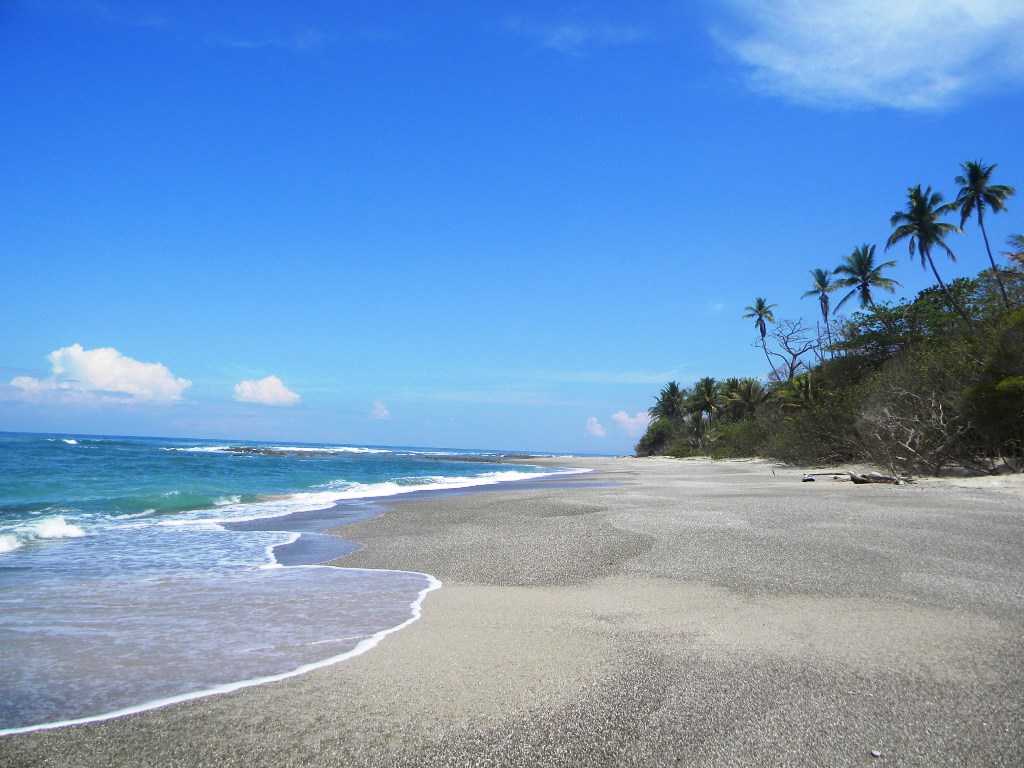
The long, curving beach of Playa Hermosa is known to be the most beautiful beach of the Santa Teresa area. Officially called “San Martin,” visitors to the beach commented so often on how beautiful it was that it became known as Playa Hermosa, or “beautiful beach” in Spanish. Playa Hermosa recently was honored once again with the Costa Rica Ecological Blue Flag Award by the Costa Rican Tourism Board for being one of the cleanest beaches in the country. Walking down the pristine beaches of Santa Teresa and Playa Hermosa, you see no high rises or crowds, only trees, jungle, sand and surf.

Pranamar beachfront villas Santa Teresa
Where to stay at Playa Hermosa, Santa Teresa, Costa Rica
Very near the giant tide pool and also the great surfing breaks of Playa Hermosa is award-winning Pranamar Oceanfront Villas & Yoga Retreat. The beautiful Bali-style beachfront hotel in Santa Teresa is a wonderful place for a relaxing Costa Rica beach vacation. Pranamar Villas specializes in Costa Rica yoga retreats, and Costa Rica surfing vacations, with daily yoga classes for hotel guests and the public.

You can’t go wrong with these recommendations: Pranamar Villas received TripAdvisor’s 2015 Certificate of Excellence, and was named a Top 5 Yoga Retreat in Costa Rica by Travel & Leisure Magazine. Santa Teresa Beach was chosen one of the Top 15 Places to Go in 2015 by Condé Nast Traveler.

Article by Shannon Farley  

jueves, 14 de mayo de 2015

Santa Teresa Costa Rica beach communities win Ecological Blue Flag

Playa Hermosa, Santa Teresa, Costa Rica
"Never doubt that a small group of thoughtful committed citizens can change the world; indeed, it's the only thing that ever has."
Margaret Mead
Walk down the Pacific beaches of Santa Teresa, Costa Rica and you’re likely to see long, empty stretches of white sand, beautiful blue rolling waves, multicolored crushed seashells and interesting rocks and pebbles. What you won’t see so much is trash.

The southern Nicoya Peninsula beaches of Playa Hermosa, Playa Santa Teresa, Playa Carmen and Mal Pais all were honored once again with the Costa Rica Ecological Blue Flag Award by the Costa Rican Tourism Board for being some of the cleanest beaches in the country. A record 108 Costa Rica beaches received Ecological Blue Flag Awards for 2014, presented at a ceremony in March 2015. Award-winning Santa Teresa Beach in Costa Rica also was chosen one of the Top 15 Places to Go in 2015 by Condé Nast Traveler.

Playa Hermosa, Santa Teresa, Costa Rica

Costa Rica’s Blue Flag award is an honor
for a community to earn. It means that community’s beach has near-perfect ocean water quality, potable water quality, coastal sanitation areas, treated waste and run-off water, garbage containers and very little litter.

At Playa Hermosa, it all started four years ago when hotel owner Tara Shaw encouraged her business neighbors to join her in cleaning the beach. “I used to go running on the beach and used to cry about all of the plastic trash. My family and I used to go out there and clean up,” said Shaw, who owns the small hotel of Villas Hermosas at Playa Hermosa with her husband, Brad. “Now, Hermosa has grown enough that a lot of people are really supportive.

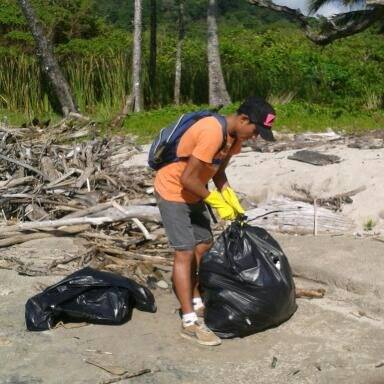
Playa Hermosa – aptly named “Beautiful Beach” – keeps its beauty thanks to the hard work and dedication of Costa Rican Maxfred Moraga and the committed business owners who sponsor him in the community beach cleaning program. Nine businesses at Playa Hermosa cooperate to pay Moraga’s salary and the cleanup expenses. Moraga works six days a week all year – with vacation time – to pick up trash brought in on the Pacific tides, that is left behind by beach-goers or washed out from nearby rivers. The rubbish is collected in extra-large garden-size trash bags, separated between garbage and recycling, and brought to a municipal trash collection spot.

Beach cleanup employee Maxfred Moraga at Playa Hermosa Costa Rica
“Such a proud moment today! Our beach, Playa Hermosa, has been given the honor by the respected Blue Flag program of the cleanest beach in the entire (large) province of Puntarenas,” wrote Shaw on the Villas Hermosas Facebook page. “Several Northern Santa Teresa / Hermosa businesses (Batik, Pranamar Villas and Yoga Retreat, Zopilote Surf Camp, The Blue Flag Ecological Award Costa RicaWhite House, Florblanca Resort, Latitude 10º Resort, Purasonica, Rancho Cielo, and us at Villas Hermosas) have been contributing for a full-time worker to pick up garbage 6 days per week for the last 4 years in our part of town, and it has obviously paid off! Thanks so much to Maxfred, our cleaner the last three years, and all contributors who help us with this program. Best. Neighbours. Ever.”

“I am happy, not only that we got the award for being one of the cleanest beaches in the country and being able to enjoy it every day, but by the fact that my kids are growing in a community where people do care,” commented Mario Matarrita, manager at Pranamar Oceanfront Villas & Yoga Retreat, which contributes to the community program. “After all, this is for our future generation, and these kinds of actions will hopefully set them on the right path.”

Pranamar Oceanfront Villas & Yoga Retreat, Costa Rica

Being right on the beach at Playa Hermosa in Santa Teresa, Pranamar Oceanfront Villas also uses its own staff to keep its area of the beach well-groomed and free of trash and debris. The Santa Teresa Costa Rica hotel specializes in Costa Rica yoga retreats and Costa Rica surfing vacations, with daily yoga classes for hotel guests and the public. Pranamar Oceanfront Villas was named a Top 5 Yoga Retreat in Costa Rica by Travel & Leisure Magazine.

Article by Shannon Farley
martes, 17 de diciembre de 2013

Santa Teresa businesses work together for Blue Flag.

I’ve been reading about ocean pollution, and the facts are really quite shocking. Apparently, it was once a common practice to “get rid of trash” by dumping it into the ocean, and there was even a positive catchphrase: “The solution to pollution is dilution.”

Pacific Ocean garbage patchPeople assumed that the oceans were so vast and deep that the trash would simply be swallowed up and we’d never see it again. How very wrong. All of that trash – pesticides, herbicides, chemical fertilizers, detergents, oil, sewage, plastic bottles, plastic bags, and other solids – dumped into the ocean from land or by ships is consumed by or ensnares marine mammals, birds or fish with often fatal results, endangering the entire ocean ecosystem.

 It swirls around in thousand-mile-wide swaths of decomposing plastic and garbage. One in the North Pacific, known as the Pacific Trash Vortex, or North Pacific Garbage Patch, is estimated to be the size of Texas and thought to contain 100 million tons of plastic. A new, massive patch was discovered in the Atlantic Ocean in early 2010. So far, five trash gyres have been found in the world.

Santa Teresa, Costa RicaWalk down the beaches of Santa Teresa, Costa Rica, however, and what you won’t see along the white sand is trash. The Pacific beaches of Santa Teresa – Mal Pais, Playa Carmen, Playa Santa Teresa and Playa Hermosa – on Costa Rica’s southern Nicoya Peninsula hold the honored Ecological Blue Flag status for having near-perfect ocean water quality, potable water quality, coastal sanitation areas, treated waste and run-off water, garbage containers and very little litter.

Bagging beach trash, Playa Santa Teresa, Costa RicaBusinesses on these four beaches have taken it upon themselves to keep the beaches clean. Since 2011, they have worked together to pay for two workers to clean each beach every week, all year long. They pick up trash brought in on the Pacific tides, or washed out from nearby rivers or that is left behind by beach-goers. The rubbish is collected in extra-large garden-size trash bags, separated between garbage and recycling, and brought to a municipal trash collection spot.

The business owners take turns in rotation to pay for the two workers and the cleanup costs. “We started in 2011 with only five or six sponsors, and now we are up to 50-60 sponsors,” said program coordinator Roberto de la Ossa. “The more business owners there are, the easier it is for everyone to maintain the program.”

De la Ossa, who is general manager at sponsor Hotel Tropico Latino, said he works with a small team of business owners to run the program. In turn, they work with the Environmental Committee of Santa Teresa, which coordinates the Blue Flag program.

Garbage and recycling bins at Playa Carmen, Santa Teresa, Costa Rica“We’re trying to promote consciousness in the area,” de la Ossa explained. “We are blessed that we have very clean water here – 75% of the criteria of the Blue Flag Program is that we have clean water. We’re still in time to conserve the environment here. If we tackle these issues now and put programs in place, the new generations coming up will be better equipped to handle these issues and we can grow sustainably.”

In 2011, beach cleanup efforts collected approximately 5,200 kilos of trash, and that was starting mid-year, de la Ossa said. In 2012, they cleaned up an incredible 10,515 kilos of garbage during the year. The program hopes to grow with more business sponsors in 2014.
"Never doubt that a small group of thoughtful, committed citizens can change the world; indeed, it's the only thing that ever has" - Margaret Mead
Hotel Tropico Latino

Hotel Tropico Latino is a small, intimate and welcoming beachfront hotel in Costa Rica in the Playa Carmen-Playa Santa Teresa area of the southern Nicoya Peninsula. The charming hotel offers a variety of accommodations spread throughout natural organic gardens. Hotel Tropico Latino is an ideal Costa Rica beach vacation destination for couples, families, surfers, yoga retreats, and well-being and health retreats.

Article by Shannon Farley
lunes, 13 de mayo de 2013

Happiness, bliss & the beauty of life on Santa Teresa Beach

Are you happy?
Costa Rica is #1 on the Happiest Planet in the world indexThat seems to be the question being asked in recent times, from boardrooms to bars, international conference centers to offices of government leaders, business schools to book stores. Are we happy? Following our bliss? Living our passion? Are we "me-focused" or "others-focused"?

The tiny Himalayan kingdom of Bhutan even measures its country's prosperity by its "gross national happiness" (GNH), measuring the spiritual, physical, social and environmental health and happiness of its citizens and natural environment. Bhutan's policy attracted great interest at the United Nations climate change conference in Doha, Qatar last December.
Costa Rica has made it to #1 on the Happy Planet Index for two years in a row (2012 & 2011), based on its national conservation policies, small ecological footprint, high quality of life and life expectancy rate all being "exceedingly above par", states Forbes Magazine. The Happy Planet Index is an annual survey conducted by the New Economics Foundation, a British think-tank that aims to measure the level of happiness in every country in the world. The ranking system establishes a solid link between happiness and the environment or nature.

Pranamar Oceanfront Villas & Yoga Retreat on Santa Teresa Beach, Costa Rica
Susan Money and Greg Mullins followed their bliss 20 or so years ago to live in harmony with nature in Costa Rica. The California couple first opened a bed and breakfast hotel, then the very successful Florblanca Hotel on Playa Santa Teresa, and now are owners of the highly popular Pranamar Ocean Front Villas and Yoga Retreat, also on Santa Teresa Beach.
"The Pranamar experience is a unique one. Rather than the typical corporate model, we work under the family model. Pranamar evolved from a sense of oneness – a desire to be in community with people we love and people who simply make us feel good," explains Pranamar owner Susan Money.
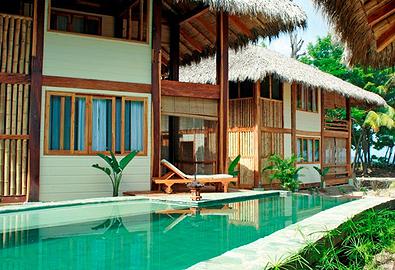
Pranamar's poolside villas on Santa Teresa Beach, Costa Rica
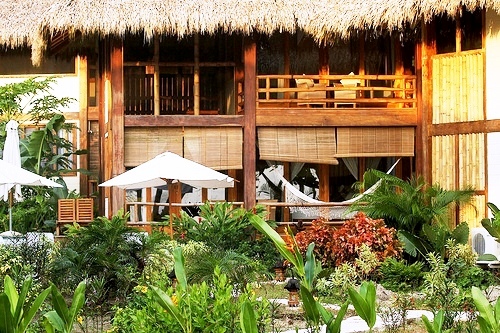
Pranamar Villas is a gorgeous, intimate luxury hotel fronting the spectacular beach of Playa Santa Teresa on the southern Nicoya Peninsula of Costa Rica. A Trip Advisor award winner, Pranamar offers luxurious two-story poolside villas, elaborate oceanfront villas and tropical bungalows, all designed with Indonesian flair. Pranamar evolved from the Susan and Greg's experience of living in the Indonesian island-paradise of Bali. They loved living alongside a river where neighbors gathered in community. In that image, they created the four poolside villas alongside the "river" of their winding saltwater pool, along with abundant lush tropical gardens throughout the property. A hidden statue here and there, shells and rocks artistically placed in the pathways, all lend beauty to the eye at every turn.
The hotel's name shows the owners' passion in what they do. "Prana" in Sanskrit means "vital energy" and "breath". "Mar" means ocean in Spanish. There is definitely an uplifting energy at Pranamar.
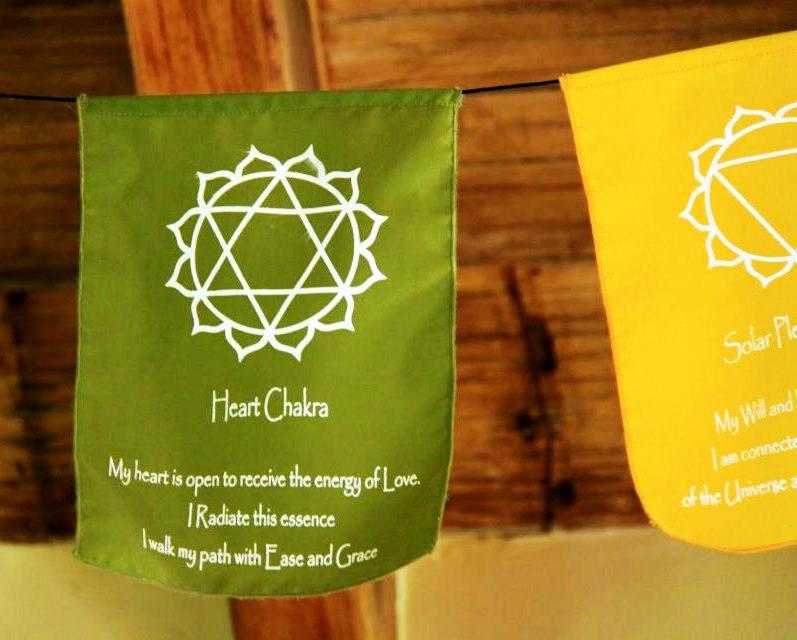
Chakra flags in Pranamar Villas' yoga shala on the beach at Santa Teresa
"At Pranamar, I feel like what we're really doing is inviting guests to experience the beauty of life," comments Nancy Goodfellow, Yoga instructor at Pranamar and Susan's daughter. "To get out of our usual routines; to step aside and see this amazing nature around us and the beauty within us – this vital energy that is all around us. Simultaneously, one will experience this deep tranquility and inner peacefulness."
Playa Santa Teresa, Costa Rica
The long tranquil beach of Santa Teresa is nearly perfect with its light beige-white sand shimmering with crushed shells and volcanic sea glass in the sunlight, shady palm and almond trees, and spectacular sunsets. Along with world-class surfing and top-quality Yoga classes, retreats and package vacations, there are numerous activities to do in the area, such as snorkeling, horseback riding, canopy zip line tours and nature tours.
"The memories and friendships established at Pranamar will linger in our collective hearts for a lifetime," notes Susan.
The supreme accomplishment is to blur the line between work and play. Arnold Toynbee
Success is not the key to happiness. Happiness is the key to success. If you love what you are doing, you will be successful. Albert Schweitzer
By Shannon Farley

martes, 19 de marzo de 2013

Uncover the Rich Indigenous History of Costa Rica

Visitors to Costa Rica’s northwest Guanacaste region probably don’t realize the area was once a thriving community for the indigenous Chorotega tribe. Indigenous history and traditions maintain a low profile in the Central American country, yet if you look closely they are all around you.
Spreading across Costa Rica’s entire northern Pacific zone, Guanacaste, for instance, is called the “Chorotega region” after its original inhabitants. The Nicoya Peninsula is named for a Chorotega chief who ruled the area when the Spanish conquistadors arrived in Costa Rica in 1523.

At the time of the Spanish conquest, the Chorotega were the largest and most technologically advanced tribe in Costa Rica, according to Encyclopedia Britannica and other historical reports. The tribe, whose name means “people surrounded by enemies”, were driven by warfare from Central Mexico many generations before the Spanish arrived and settled in southern Nicaragua, Guanacaste and the Nicoya Peninsula.
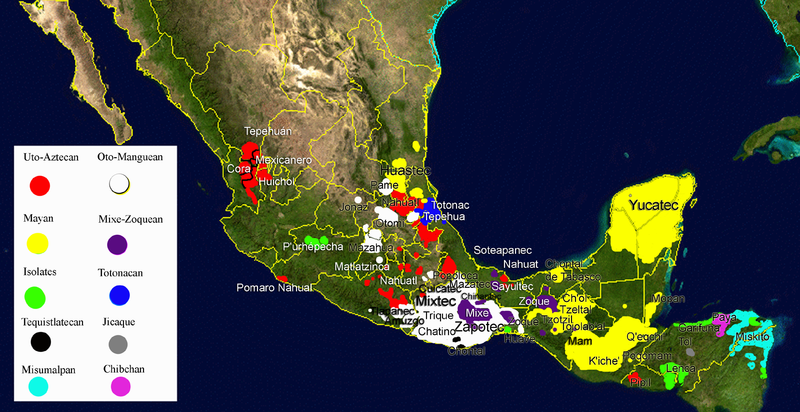
Mesoamerican languages in Central America

They spoke Mangue, an Oto-Manguean language from Central Mexico that was shared by indigenous groups in Honduras, Nicaragua and Costa Rica. Many of the place names in northwest Costa Rica are Chorotegan, including Guanacaste – name of the northern Pacific province and Costa Rica’s national tree. The word “Guanacaste” means “ear tree” for the trees’ seeds which resemble a human ear.
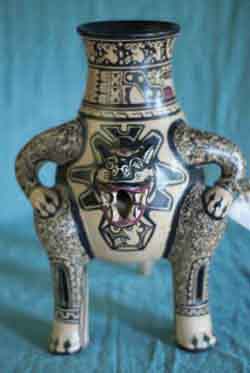
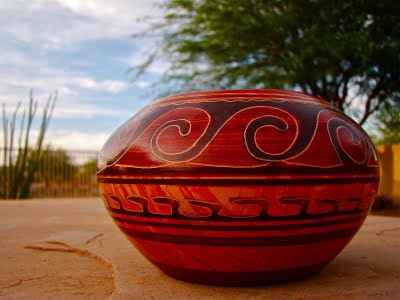
Traditional Chorotega pottery in Costa Rica reveals Aztec historical influences

Stretching all the way from the Nicaraguan border in the north through the Nicoya Peninsula, the Chorotega people lived in towns – some as large as 20,000 inhabitants – that were built around a central plaza, according to historical reports. Their houses were rectangular, built of wood with straw roofs. The Chorotega maintained strong religious rituals and were competent astronomers and mathematicians.

Corn was vitally important in the Chorotega culture, and affected the indigenous people’s agriculture, customs, artistic forms and religious beliefs, reports the Encyclopedia Britannica. Corn was the basis of their diet, along with beans, squash, cacao, meat and fish. The Chorotega had an active economic life with commerce and markets, and a semi-democratic social structure in which chiefs were elected. Cacao beans served as currency.

The Chorotega frequently fought with neighboring peoples, states the Encyclopedia Britannica. Tribal warriors wore padded cotton armor and fought with bows and arrows and wooden swords tipped with small flint knives. Although they were eventually conquered by the Spanish, the Chorotega were reported to be courageous warriors who fought hard against the invaders.

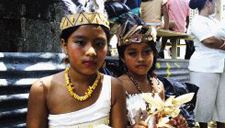
Children of the Chorotega indigenous tribe in Costa Rica

The history of indigenous peoples in Costa Rica is much like the rest of the Americas. The Europeans brought diseases to which the native population had no immunity; entire tribes were killed. Archaeologists calculate that up to 400,000 native people lived in Costa Rica when Columbus arrived in 1502, between the main tribes of the Chorotega, Guaymi (Ngabe), Terraba, Boruca, Maleku, Huetares, Bribri and Cabecar. Ultimately, it was the 16th century slave trade that decimated the Chorotegas. The Spanish rulers dominated the tribe by sending thousands to work in the gold mines of Panama and Peru.

Chorotega pottery from the Nicoya Peninsula is famous in Costa Rica

Today, there are only about 64,000 indigenous people living in Costa Rica, according to official reports. The Chorotega language, culture and community have been largely lost, except for the indigenous reserve of Matambú, located near the town of Nicoya. Some customs and traditions have survived, such as the production of ceramic pottery and figurines. Chorotegan pottery is famous in Costa Rica, and is still being made in the towns of Guaitil and San Vicente.

Pranamar Oceanfront Villas and Yoga Retreat in Santa Teresa, Costa Rica

Visit Costa Rica’s Nicoya Peninsula
and the fascinating land of the Chorotega people when you stay at Pranamar Oceanfront Villas and Yoga Retreat in Santa Teresa. The beautiful, luxury boutique hotel is located right on the Pacific Ocean at Santa Teresa Beach. Two-story poolside villas and elaborate beachfront bungalows are set in extravagant tropical gardens near a lovely free-form saltwater pool. Winner of Trip Advisor’s Traveler’s Choice and Certificate of Excellence awards, Pranamar Villas offers you daily in-house yoga classes, regular yoga retreats and workshops, all-inclusive yoga vacations, front-yard surfing, and surfing and yoga holidays.

By Shannon Farley