Mostrando entradas con la etiqueta costa rica nature. Mostrar todas las entradas

lunes, 11 de mayo de 2015

What you need to know about visiting Costa Rica in rainy season

Costa Rica rainy season rainbow

Costa Rica welcomes rainy season
(also called the “green season”) like a parched traveler reaching an oasis after a long, dry desert-crossing. Dry season dust is gone and Costa Rica’s landscape springs back to life with lush green vegetation, carpets of blooming flowers, and new animal life.
Costa Rica in general has two major seasons“summer,” or the dry season from December to April, and rainy season from May to November. Mornings during rainy season are almost always sunny, with showers in the afternoons or evenings, which thankfully cool the temperature. And there may be many days when it does not rain at all. The exception is that the Costa Rica Caribbean Coast is rainy most of the year and has its Caribbean Summer from about mid-September to mid-November – when the rest of the country is soaked.
Caribbean Costa Rica Summer

Those “in the know” about traveling to Costa Rica know that rainy season means good deals, lower rates in hotels, and fewer crowds. Besides, if you are going to visit a rainforest or a cloud forest, you should expect rain and clouds some of the time!
12 THINGS TO KNOW ABOUT VISITING COSTA RICA IN RAINY SEASON:
  • Costa Rica rainforestRainy season paints the landscape lush, verdant and colorful – a real jungle!
  • Mornings are almost always hot and sunny. Rain usually falls for a few hours in the afternoon or at night.
  • Rain helps bring the temperature down.
  • Sea turtles come to nest on both the Pacific and Caribbean coasts during this period, making it “turtle season”.
  • Discover the two-week “mini-summer” that happens in July.
  • Rain fills the rivers making it the best time for whitewater rafting.
  • Pacuare River whitewater rafting Costa RicaRemember to carry an umbrella when you go out for the day or in the afternoon. Invest in one of those huge golf umbrellas while you are here; you will understand why.
  • Plan your day to do all activities – tours, sightseeing, errands, shopping – in the morning and leave the afternoon for indoor pastimes like museum visits, visiting with friends, reading, emails, naps, etc.
  • Canopy tour Costa RicaYou may not want to get up early on your vacation, but think again. You want to do all tours in the morning during rainy season, when it is dry and sunny and pleasant. The earlier in the morning, the cooler the temperature and the more wildlife you see. Hiking or ziplining through a rainforest in a torrential downpour is definitely a memorable experience, but is not very comfortable.
  • Be sure to rent a 4x4 vehicle in rainy season, when unpaved roads turn to muddy bogs.
  • Skip off to the Caribbean Coast in October for Costa Rica Caribbean Summer.
  • You can find better values in rainy season on vacation packages, hotels, tours and transport.
See why rainy season is a great time to travel to Costa Rica on vacation. Design your Costa Rica holiday with Horizontes Nature Tours. The travel agency in Costa Rica has 31 years of experience creating Costa Rica nature holidays, Costa Rica family trips and Costa Rica beach vacations.

Article by Shannon Farley

jueves, 16 de abril de 2015

In honor of Earth Day, 4 Costa Rica National Parks you should visit

Earth Day 2015In celebration of Earth Day 2015 – celebrating its 45th anniversary on April 22, 2015Horizontes Nature Tours in Costa Rica asked one of their long-time naturalist guides what was his favorite element of Costa Rica nature. Costa Rica’s national parks were his answer.

From a country that was nearly devastated by deforestation by the early 1980s, today over 52 percent of Costa Rica’s territory is protected between national parks, private reserves and wildlife refuges. Costa Rica’s progressive reforestation and environmental protection have earned not only world respect for the nation’s green policies, but also attracted more than 2 million visitors last year to experience Costa Rica’s nature.

“We created our national parks from our past leaders’ convictions to protect the richness of our amazing ecosystems,” noted Gustavo Abarca, who has been a naturalist guide for 22 years – 20 with Horizontes Nature Tours.

Costa Rica rainforest

Gustavo says he has visited nearly all 25 Costa Rica national parks. He enjoys them all; and he has his favorites. Here are Gustavo’s top picks for Costa Rica national parks you should visit:
Tortuguero National Park

“I have had people who have traveled to the Amazon and they are amazed with the amount of wildlife that can be seen in a couple of hour’s boat trip in Tortuguero,” said Gustavo. “You can see three species of monkeys in less than two hours on a tour.”

Costa Rica national park Tortuguero

Corcovado National Park


“Corcovado is such a sensation. In Manuel Antonio you can see all of the cute animals – the sloths, the monkeys – but in Corcovado you see pristine nature. You can get lucky and see a tapir, an ocelot, or a puma. You can be walking along and run into a big troop of spider monkeys,” Gustavo explained. “Corcovado is for people with a passion for nature, interested in seeing the best well-kept rainforests on the Pacific Coast of Central America. It is for people who want to be the most off the beaten path, isolated and in contact with nature.”

Costa Rica national park Corcovado

Piedras Blancas National Park
“The Piedras Blancas National Park and the buffer zones of the Golfito Reserve and the other private reserves are very unique and are always a favorite with my clients,” Gustavo commented.

Piedras Blancas National Park

Rincon de la Vieja National Park


“I really enjoy Rincon de la Vieja. The contrasts between the fumaroles, boiling mud pits and waterfalls on one side, and then the light blue rivers and forest on the other side of the Continental Divide are completely different. This is one of the parks that are visually really unique,” Gustavo noted.

Costa Rica national park Rincon de la Vieja
Isn’t it time you visited Costa Rica?
Design your Costa Rica vacation with Horizontes Nature Tours. The Costa Rica travel experts offer four fantastic Costa Rica national park vacations, Costa Rica nature holidays, Costa Rica family trips and Costa Rica beach vacations. Let’s take care of our planet on Earth Day and every day.

Article by Shannon Farley

jueves, 20 de junio de 2013

Extraordinary wildlife abounds at Veragua Rainforest

What if I told you there was an animal without lungs that lives on land and can grow back any limb of its body?

Crazy, you say? Well, in the Costa Rican Caribbean rainforest, there is a species of salamander that can.
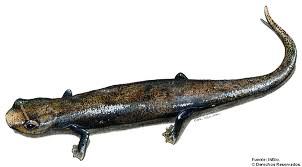
Costa Rica salamander, photo courtesy of InBioSalamanders are amphibians that are typically characterized by a lizard-like appearance, with slender bodies, short noses, and long tails, according to Wikipedia. There are approximately 550 species of salamanders that live in Temperate and Neotropical zones around the world.

Unique among vertebrates, salamanders are capable of regenerating lost limbs. For instance, they often lose their tail when attacked in order to escape quickly and distract their predator. Within only a few weeks of losing a piece of limb, a salamander perfectly reforms the missing segment, notes Wikipedia.

Salamanders' limb regeneration has been the focus of significant interest among scientists, because they are considered the epitome of perfect regeneration. Researchers have been trying to find out the conditions required for regeneration to be able to duplicate the process with humans.
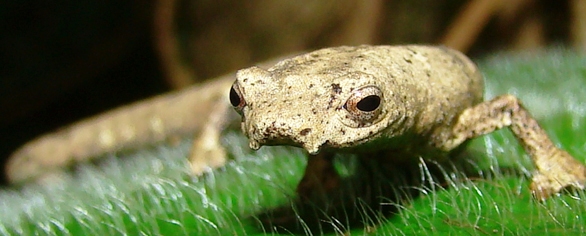
A lungless Bolitoglossa colonnea salamander at Veragua Rainforest, Costa RicaThe salamanders that inhabit Costa Rica also have no lungs, so their respiration occurs through their delicate skin and the tissues lining their mouths. Their moist skin usually makes salamanders reliant on habitats in or near water, or in moist ground such as in the rainforest.

At Veragua Rainforest in Costa Rica's Caribbean area, there is an abundance of salamanders. The diversity of amphibians and reptiles of Costa Rica's Central Caribbean had been little studied until the University of Costa Rica and Veragua Rainforest's biologists began investigating the region.

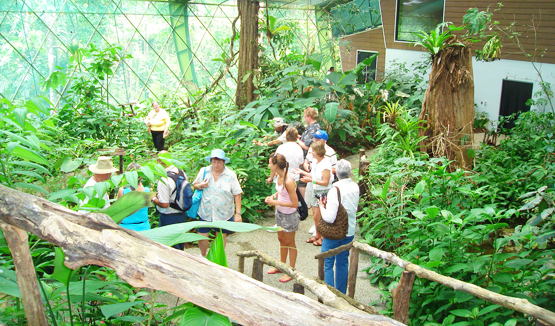
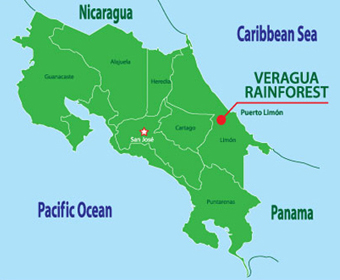
Veragua Rainforest Research & Adventure, butterfly garden, Costa RicaVeragua Rainforest is a 1,300 hectare (3,212 acre) biology research site and adventure center, located about an hour inland from the Caribbean Coast and the port town of Limón. It is an area of dense tropical rainforest in the foothills of the Talamanca Mountains bordering the La Amistad ("Friendship") International Park, the country's largest and most remote national park that is shared by Costa Rica and Panama. Veragua's biologists partner with the University of Costa Rica (UCR), the National Institute of Biodiversity (INBio), and the National Museum of Natural History to preserve the area's population of frogs, snakes, lizards, iguanas, insects, butterflies and birds.

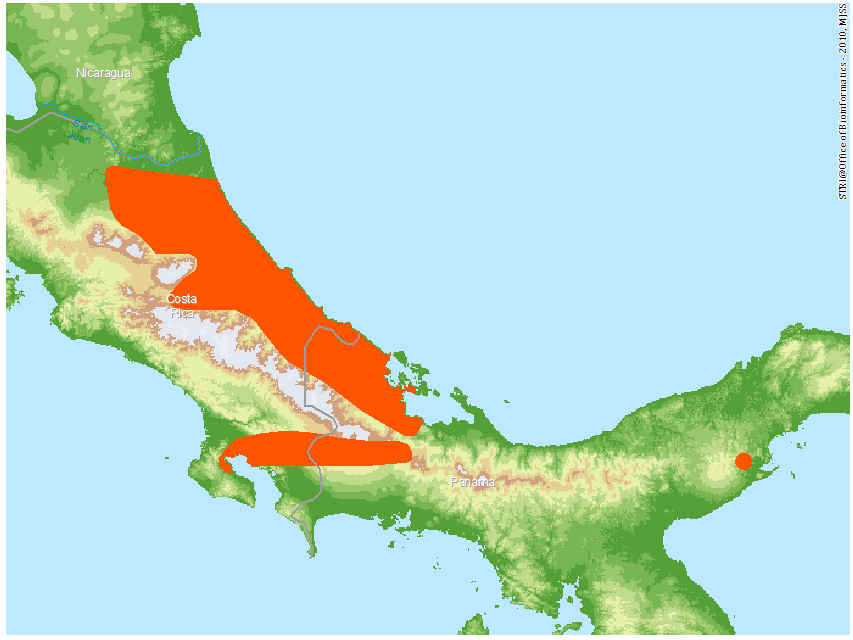
Bolitoglossa colonnea habitat map, photo courtesy of Smithsonian Tropical Research InstituteThe most popular salamander at Veragua Rainforest is the La Loma Salamander, or Tropical Climbing Salamander (Bolitoglossa colonnea), a species of lungless salamander found in Costa Rica and Panama, reports resident biologist Wagner Chaves. The La Loma Salamanders are native to the Western Hemisphere, from British Columbia to Brazil. The species is threatened by habitat loss – tropical moist lowland and tropical montane forests.

Veragua Rainforest, Costa Rica on mapVeragua Rainforest offers an excellent educational opportunity for students and educators with hands-on research of rainforest life. The park is not-to-be-missed when visiting Costa Rica's Caribbean area. The property contains a biology research station, wildlife habitats, rainforest walking trails, a river and waterfall, an aerial tramway, a canopy zip line tour, student group accommodations, and a restaurant, café and souvenir shop. The Park is open to day visitors Tuesday to Sunday, from 8:00 am to 3:00 pm.
By Shannon Farley