Mostrando entradas con la etiqueta costa rica nature tours. Mostrar todas las entradas

miércoles, 12 de marzo de 2014

Sensoria is an extraordinary Guanacaste Costa Rica Eco Tour

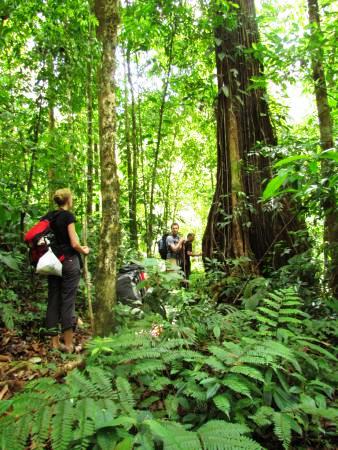
Tall trees at SensoriaEvery young child has a special place where they feel happiest. For Fernando Madrigal, as a young boy growing up in Costa Rica, that place was his grandparents’ farm – the Finca La Troya in the Orosi Valley of Cartago.

“I spent practically all of my childhood and youth on this farm until my grandparents sold it,” reflected Madrigal. “I remember that La Troya was a magical place. There was a place at the top of the farm where there was a mountain with primary forest. My uncle, Rodrigo Madrigal Montealegre, would take me, my brother and my cousins walking there. The forest was full of monkeys, sloths, vines hanging from the trees, natural springs full of water and spectacular nature. To me, it was the most beautiful place in the world and I was always very happy there.”

The desire to recapture his childhood magical forest led Madrigal in 2008 to seek out another place of amazing Costa Rica nature. “I went to a prestigious real estate agency in Costa Rica and asked them to find me the wildest place, with spectacular nature, abundant wildlife and plentiful natural springs. We found exactly what I was looking for in the northern foothills of the Rincón de la Vieja Volcano, which we now call ‘Sensoria’,” he said.

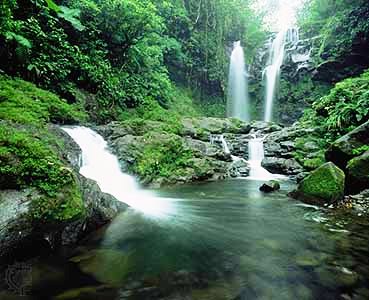
Aguilar Waterfall, SensoriaTalk about an enchanted paradise. On the private nature reserve of Sensoria, rainforest grows thick and wild, sky blue volcanic mineral streams and waterfalls flow bountifully, steaming thermal springs bubble out of the earth, and exotic animals roam freely.

As its name implies, Sensoria is a place for your senses: to hear, see, smell, touch and taste. It is an extraordinary Costa Rica Eco Tour that takes you hiking through pristine wilderness to swim in hidden waterfall pools and volcanic thermal springs. Madrigal said they created the tour for nature lovers to be able to experience the breathtaking beauty of a rainforest. Trails are as natural as possible and accessible for any ambulatory person in good physical condition, he said.
Sensoria at Rincon de la ViejaSensoria’s proximity to the Rincon de la Vieja Volcano and National Park, and its verdant jungle on the volcano’s northeastern slope, make it a unique Guanacaste tour. The region of the massive Guanacaste Conservation Area is reported to hold 2.6% of the world’s biodiversity. Madrigal said they protect the fragile ecosystem by limiting the number of people visiting the reserve: maximum 30 persons in a day on two or three different tours.

“This place is easily the most gorgeous place on planet Earth! It feels like a dream here. It’s hard to believe nature can feel so sublime. Thank you for caring for this place and keeping it sacred,” summed up one Sensoria visitor.

How to get there: Sensoria is located north of Liberia and 4.5 km north of the Rincon de la Vieja Volcano in Guanacaste. The hiking tour lasts three to four hours.
Article by Shannon Farley

martes, 25 de junio de 2013

Costa Rica's Carara National Park is tops with nature lovers

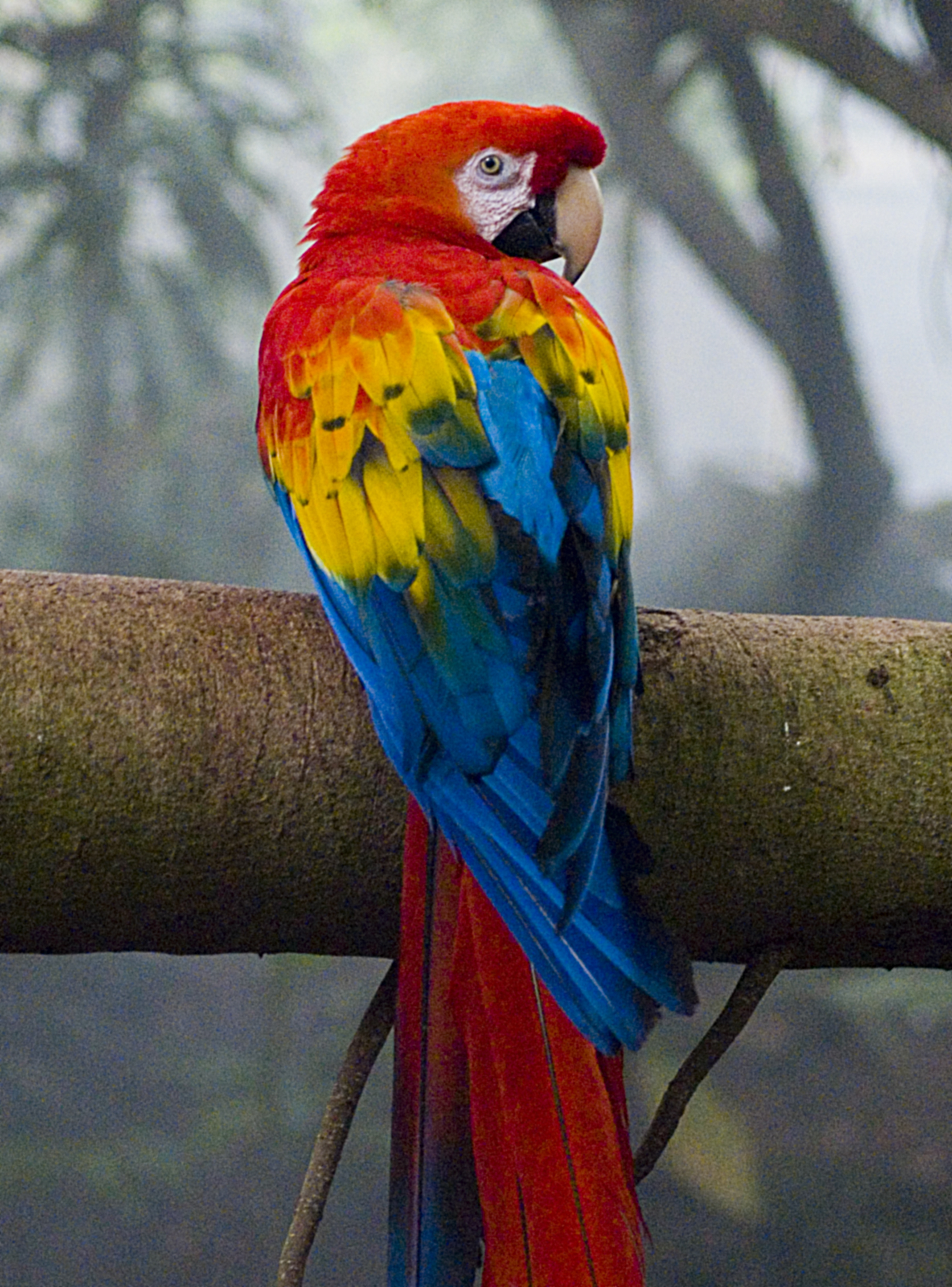
Many wild Scarlet Macaws live in Costa Rica's Carara National ParkOne of the most brilliantly beautiful tropical birds is definitely the Scarlet Macaw (Ara macao). Its loud, raucous squawks carry for miles, so usually you hear them before you see them. When you do sight a Scarlet Macaw in the wild, they are breathtaking – fire engine red bodies with sunshine yellow and royal blue wing feathers tinged with a bit of green, and a distinct stark white patch around both eyes.
An endangered species, Scarlet Macaws live in tropical forests from Mexico to South America. In Costa Rica, they live in dry, moist, and wet tropical lowland forests along the Pacific Coast where large mature trees provide nesting and food of nuts, fruits and flowers.

One of the best places to see wild Scarlet Macaws is at Carara National Park. You can also see them along the Central Pacific Coast from Herradura to Manuel Antonio, and in the Corcovado National Park on the Osa Peninsula.

Carara National Park is located in a transition zone between tropical dry forest of Costa Rica's Northern Pacific and tropical rainforest of the Southern Pacific. This makes the Park home to a vast variety of wildlife and plants. Carara is one of 28 national parks in Costa Rica. Spannng 12,950 acres, it was created in 1978 first as a biological reserve and then made a national park in 1998.

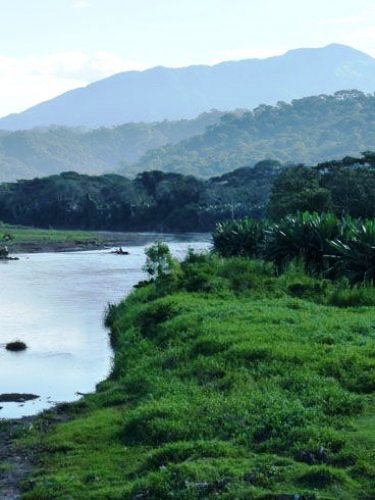
Carara National Park - Tarcoles River, Central Pacific, Costa RicaCarara is exceedingly popular due to its easy accessibility and proximity to the capital city and the highly-trafficked beach town of Jaco, the Los Sueños Resort at Herradura Bay, and the Pacific cruise ship port of Caldera. But if you get there early, right when the park opens, or go late in the day near closing time, you can beat the crowds and have the nature and wildlife to yourself. Early morning, or around sunset is often the best time to see animals living in the park, especially Scarlet Macaws.

The Carara National Park protects the Tarcoles River valley on the Pacific Coast. Its forests are dense and high, and the park has a mixture of primary and secondary forests, lagoons, rivers and waterfalls. The huge trees here are often covered with vines and epiphytes. Pre-Columbian archaeological sites are scattered throughout the area.

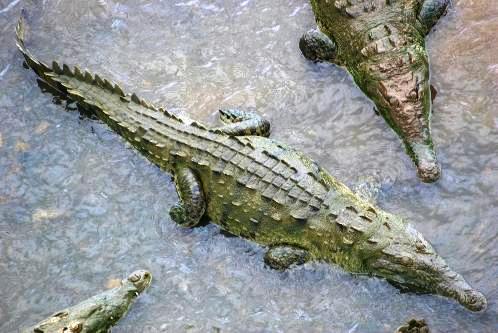
Tarcoles River crocodiles, Costa RicaThe park's name is the native Huetar word for crocodile. Visit the park and you'll understand why since the Tarcoles River, which forms the park's northern boundary, is famous around the world for its giant and plentiful crocodiles. The Tarcoles River Bridge on the Coastal Highway is a favorite place for tourists to stop and view the monster-sized crocodiles below. Boat tours on the river also are very popular.

More than anything, though, Carara National Park is known for being a bird watching paradise. About 48% of Costa Rica's avian species, including one of the country's largest remaining wild populations of Scarlet Macaws, live in the park. More than 360 species of birds have been recorded in Carara, including toucans, parrots, aracaris, trogons, kingfishers and herons.
Other wildlife you are likely to see include white-faced Capuchin monkeys, agoutis, coatis, sloths, peccaries, anteaters, armadillos, boa constrictors and poison-arrow frogs.

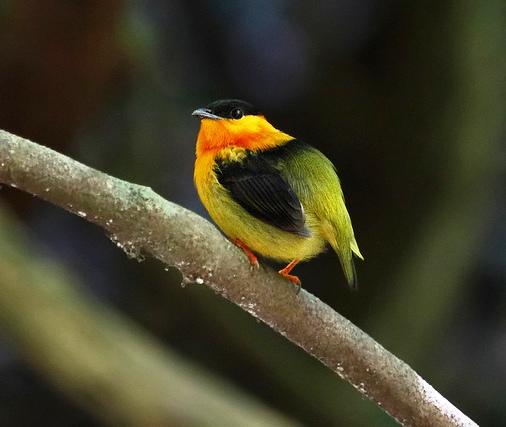
Carara National Park, orange-collared manakin, Costa RicaThe park has two trails to explore, each of which is approximately 2 miles (3 km) in length. There is a new shorter wheelchair accessible trail as well. It is best to go with a naturalist guide who will point out plant and animal species and explain the park's ecology.
Carara National Park is located 9.3 miles (15 km) north of Jacó and about an hour from San Jose. The Quebrada Bonita Ranger Station sits along Hwy 34 just minutes south of the Tarcoles River. The rangers will be happy to give advice and current information on wildlife. The park opens at 7 a.m. and closes at 4 p.m. The entrance fee is $10. Don't forget to bring insect repellent.

You can visit Carara National Park with Costa Rica travel agency Team CRT on their 7-day/6-night Costa Rica National Parks vacation package. The agency knows the best of the country, what to do and see, and they personalize it for you, designing your Costa Rica vacation to fit exactly what you want. From nature tours to beach destinations, adventure tours, family vacations, relaxation vacations, honeymoons and golf vacations, Team CRT delivers you unforgettable Costa Rica vacation packages. They also offer vacation packages to neighboring Panama and Nicaragua.

Team CRT is committed to sustainable tourism vacations that actively involve the local community in Costa Rica.
By Shannon Farley

martes, 7 de mayo de 2013

Boost your well-being in Costa Rica's green space

UK study says people are happier outdoors in nature. Visit Costa Rica for the green!Would you be happier living in a greener area?
A UK study says you would. New research from the University of Exeter Medical School and the European Centre for Environment & Human Health in England has found that "people living in urban areas with more green space tend to report greater well-being than city dwellers that don't have parks, gardens, or other green space nearby." The research, led by Dr. Mathew White, was published in the journal Psychological Science.
The U.S. Environmental Protection Agency defines "green space" as land that is partly or completely covered with grass, trees, shrubs, or other vegetation; green space includes parks, community gardens, and cemeteries.
Costa Rica is full of green spaces like this oneDr. White and his team of UK researchers analyzed data from a national survey of more than 10,000 people for nearly 18 years between 1991and 2008. They found that persons who live in green areas have higher life satisfaction and less depression and stress than those who live in concrete-dense areas with few trees and lawns, states the journal Scientific American. This trend held even if residents experienced changes in their income, employment, marital status, housing and health.
Data was derived from the British Household Panel Survey, a nationally representative longitudinal survey of households in the UK that ran annually from 1991-2008, containing over 5,000 households and 10,000 individual adults.
The new research does not prove that moving to a greener area will necessarily cause increased happiness, but it does fit with findings from experimental studies showing that short bouts of time in nature can improve a person's mood and cognitive functioning.
Spend time exercising in the outdoors to boost your mental healthBeth Murphy, information manager at the mental health charity "Mind" in England, reports: "For people living busy lifestyles in densely populated areas, being able to get outdoors and access green space is a great way to escape the stresses of day-to-day life. Our research has shown that 94% of people who took part in outdoors 'green exercise' said it benefited their mental health and can have huge impacts on physical health."
Costa Rica, known as the "Switzerland of Central America," has no shortage of green spaces. The entire country is covered with green – rainforest, cloud forest, tropical forest (lowland, moist and dry), swamp, pasture land, coffee plantations, fruit tree orchards, and plantations of sugar cane, bananas and pineapple. The list goes on and on. I'm looking out my window now, from my desk, at a sea of green grass, flowers, trees and shrubs just in my own garden.
The author's garden view in Costa RicaReady for a mental health boost of your own? Escape the stress of daily work, commutes, city life, etc. and dive into Costa Rica's greenery. Walk in a dense forest beneath trees hundreds of feet tall. Fly on a zip line through the emerald tree canopy. Lounge under a green palm tree beside an aquamarine sea. Tour a coffee plantation and see how that great morning beverage is made. Discover a lost "you" in the misty verdant cloud forest. The possibilities are endless. Seeing "green" yet?
Costa Rica travel agency Team CRT will put you in the heart of Costa Rica's nature. The agency knows the best of the country, what to do and see, and they personalize it for you, designing your Costa Rica vacation to fit exactly what you want. From nature tours to beach destinations, adventure tours, family vacations, relaxation vacations, honeymoons and golf vacations, Team CRT delivers you unforgettable Costa Rica vacation packages.
Team CRT is committed to sustainable tourism vacations that actively involve the local community in Costa Rica.
By Shannon FarleyTravel to Costa Rica for forests like this with Team CRT