lunes, 25 de noviembre de 2013

Playa Guiones by Nosara is one of the best surfing beaches in Costa Rica

Most people visiting Nosara head straight for Playa Guiones, which with its beautiful white sand and consistent surf break, is one of Costa Rica's most favored surfing beaches.
This breezy Blue-Flag beach is reputed to have the most consistent surf on Costa Rica's Pacific Coast with "surf-able waves here over 300 days a year," reports the Visit Nosara tourism website. Guiones Point at the south end of the beach juts way out into the Pacific and is a swell magnet, attracting both north and south facing swells. The sandy bottom beach break at Guiones stretches up and down the 7 km (4.5 mile) bay, with waves for every skill level – from beginner to expert, long boarder to short boarder.
Backed by lush vegetation, Playa Guiones is also a haven for sun lovers, beachcombers, joggers and anyone looking for a fun bike ride down the beach. However, it is important to note that there is a 3-meter (9-foot) tide differential, and the beach is rather narrow at high tide.
Offshore winds blow most every morning during dry season, from December until the end of April, making for great surf conditions early – most surfers are riding the waves between 7:00 a.m. and 10:00 a.m., then coming back for a sunset session if conditions allow. The wind usually switches onshore by 10:00 a.m., although there are often days during December and January when offshore breezes blow almost all day long, notes Visit Nosara.

When the big swells come in, waves at Playa Guiones can be giant and powerful, and should be taken with extreme caution; Nosara tourist information recommends only experienced surfers should paddle out in big surf. Additionally, tourist information cautions surfers during high tides, when rip currents and surf are strongest.
Just north of Playa Guiones, Playa Pelada is another pretty white-sand beach where the water is a little calmer. Waves here are better suited for beginners. There are tide pools to explore, lots of trees for shade, and it is a great spot for viewing Nosara's spectacular sunsets.
Check out the daily Nosara Surf Report, and see how the waves are in real time on the Nosara Live Cam. Surfing Nosara also provides a detailed, long- and short-range Nosara Surf Forecast.
Hotels in Nosara, Costa Rica
Located on a remote stretch of the Nicoya Peninsula in Guanacaste, just north of Samara, L'acqua Viva Resort & Spa is a luxury boutique hotel by Playa Guiones. The hotel's name means "live water," which is a key element flowing around the exotic Bali-style architecture. L'acqua Viva is part of the Enchanting Hotels group of Costa Rica.
Article by Shannon Farley
Guarding the King of the Jungle on the Osa Peninsula

Like the lion or the tiger, the jaguar is the "king of the jungle" in the Americas. It is the largest feline in the Americas and the third largest in the world, notes Wikipedia. With a range extending from Southwestern United States and Mexico across much of Central America and south to Paraguay and northern Argentina, there are only an estimated 15,000 jaguars left in the wild, according to the World Wildlife Fund (WWF).
"The jaguar is still an abundant species, but is threatened by habitat loss and persecution," notes a 2008 report by the International Union for Conservation of Nature (IUCN). "Due to loss of habitat, poaching of prey and fragmentation of populations across portions of the range, this species is considered to be 'near threatened.' If threats continue at the current rate, the species will likely qualify for 'vulnerable' status in the near future."
This spotted cat most closely physically resembles the leopard, although it is usually larger and stockier, and its behavior is more similar to that of the tiger. Jaguars prefer dense rainforest for their habitat, but will range across a variety of forested and open terrains; they usually stay near water, and jaguars are noted for enjoying swimming like tigers.

In Costa Rica, the Osa Peninsula is an important refuge for the jaguar. The large cats roam between the vast Corcovado National Park, the biological corridor of the Golfo Dulce Forest Reserve, and the Piedras Blancas National Park. The biggest threat to the jaguar population is being killed by farmers, reported a 2011 article on jaguar conservation by the Tico Times. According to Eduardo Carrillo, biologist and director of the International Institute of Conservation and Wildlife at the National University (ICOMVIS-UNA) in Heredia, the conflict between farmers and jaguars has resulted from the loss of the wildcats' natural prey.
"Much of the reason that jaguars enter farms to attack cattle is because sport hunting has diminished their principal prey and sources of food in protected areas," Carrillo said. "People kill the principal prey of the jaguars and it leaves them without sufficient food. As a result, they leave the protected areas and kill cows and pigs, which results in the jaguars being killed by farmers. In Costa Rica, it is the principal cause of the decreasing population of jaguars."

In Puerto Jiménez, Yaguará (the native word for jaguar) is a non-profit, non-governmental organization that protects wildlife, mainly wild cats. They work with the community and the National Parks system to study jaguars and ensure their survival and also for their prey throughout southern Costa Rica and northern Panama. Yaguará is experimenting with alternative strategies, such as a farmer compensation program when a wildcat kills an animal.
The organization has created an extensive network of infrared "camera traps," which use motion detectors to capture on film anything that passes by the camera. Yaguará's scientists use the information to study the Osa's wildcat populations, especially those of ocelots, pumas and jaguars.
Playa Nicuesa Rainforest Lodge, across the Golfo Dulce from the Osa Peninsula, also has installed camera traps to record wildlife activity in their 165-acre private rainforest preserve. The Playa Nicuesa Reserve borders the Piedras Blancas National Park, which connects to the Osa Peninsula and Corcovado National Park, so it is feasible that they could capture on camera the same jaguars that roam the Osa.
Playa Nicuesa Rainforest Lodge is an environmentally sustainable lodge on the pristine Pacific coastline of the Golfo Dulce. The award-winning eco-lodge caters to travelers interested in ecotourism, nature and adventure. They offer family vacations, honeymoon trips, nature and adventure vacations, and yoga classes and retreats.
Go for the Guanacaste cowboy life at Hacienda Guachipelin.
It is said in Costa Rica that the best "all-terrain vehicle" for navigating the country is a horse. Costa Ricans love horses and their riding traditions – their equestrian roots coming from the Spanish who brought horses with them to Central America in the 16th century.
 The northwestern province of Guanacaste is the heart and soul of Costa Rica's equestrian life. Here, vast rolling plains, towering volcanoes and mountains, and a sunny, dry and hot climate of the dry tropical forest create perfect ranching conditions. For generations, Guanacaste has been dedicated to working the land, and cattle and horse ranching. Even though the region's main economic activity is now tourism, the traditions of "sabanero" (cowboy) folklore, customs, music and dance are deeply rooted.
In the golden savanna at the base of the Rincon de la Vieja Volcano, Hacienda Guachipelin Hotel is a working horse and cattle ranch, in addition to being an active eco-tourism hotel. In the 19th century, the immense Hacienda ranch once stretched from the tip of the Rincón de la Vieja Volcano all the way to the Pacific Ocean. Since 1975, Tomás Batalla Esquivel, a renowned cattle rancher and purebred Spanish horse breeder, has been keeping the ranching legacy alive with his family.
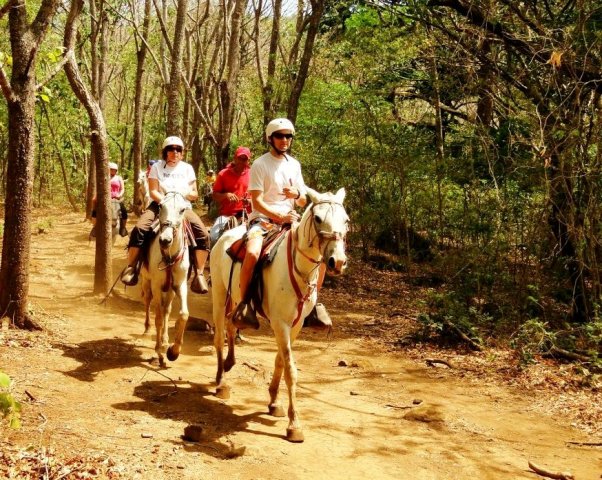 Today, the property measures nearly 3,400 acres and includes conservation areas for tropical dry forest and endangered native tree species. Hacienda Guachipelin offers seven different horseback riding tours riding the trusty ranch horses on scenic forest trails to the Rincon de la Vieja National Park or waterfalls or natural thermal springs. There is even a "Cowboy for a Day" tour, where you help out the real ranch cowboys in the stables and corral, milk cows, saddle and ready the horses, and ride out to herd cattle or other horses.
For an authentic experience of Guanacaste culture, and an active vacation at the Rincón de la Vieja Volcano, Hacienda Guachipelín Hotel is an ideal place to stay. The first-class ecotourism lodge offers thrilling canopy ziplines, canyoning, waterfall rappelling, river tubing, horseback riding, nature trails, mountain biking and thermal springs.
Article by Shannon Farley
sábado, 23 de noviembre de 2013
viernes, 22 de noviembre de 2013
jueves, 21 de noviembre de 2013
Discover the magic of Costa Rica’s South Caribbean Coast
Costa Rica's south Caribbean Coast is a magical place. South of Limon, the southern Caribbean beach towns of Cahuita, Puerto Viejo and Manzanillo are ideal destinations for a Costa Rica vacation. Puerto Viejo is the most developed area with a thriving multicultural community, international restaurants, and a diverse array of hotels.
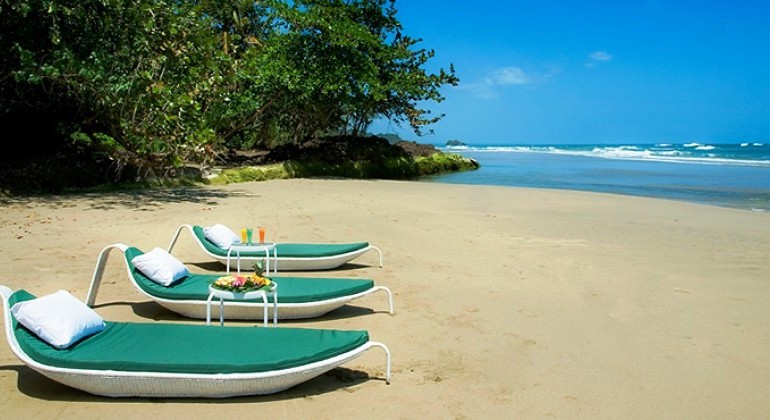 Not as well traveled, simply because Costa Rica's larger Pacific Coast gets most of the attention, the southern Caribbean keeps a quieter, more peaceful tone. Surfers know about Cahuita, Puerto Viejo and Gandoca, renowned for their great waves. Scuba divers and snorkelers certainly know about the marvels of the crystal-clear Caribbean Sea and coral reefs at the Cahuita National Park and offshore from the Gandoca-Manzanillo National Wildlife Refuge.
Beach lovers delight in having the black and golden sands on the beaches almost to themselves.
 Le Caméléon ("The Chameleon") is one of the finest hotels on Costa Rica's Caribbean Coast that caters to upscale travelers. The unique boutique hotel with a relaxed vibe is across the street from the beautiful golden sand Playa Cocles, where the hotel has a private beach club.
Le Caméléon blends steamy jungle with modern architectural design. The hotel's decor is pure white with lively splashes of color in cushions, wall paintings, and strategically-placed colored LED lights. Like a chameleon, these decorative elements change every day. Guest rooms follow the theme, being bright white with vividly hued wall hangings, bathmats, towels and bed pillows that rotate colors daily.
At Le Caméléon, an Enchanting Hotel Costa Rica, you will enjoy a serene and relaxing experience in the rainforest, while being pampered in sophisticated warmth with a sense of fun.
Article by Shannon Farley
Suscribirse a:
Entradas (Atom)