Mostrando entradas con la etiqueta costa rica biodiversity. Mostrar todas las entradas

martes, 26 de enero de 2016

Incredible Osa Peninsula Costa Rica Nature Tour: Casa Orquideas Botanical Garden

Untitled Document Orchid at Casa Orquideas Botanical Garden Golfo Dulce Costa Rica
If you plan to visit the Golfo Dulce/ Osa Peninsula region on your Costa Rica vacation, one of the most wonderful day tours you can take is to Casa Orquideas Botanical Garden. Casa Orquideas is one of the oldest and most interesting botanical gardens in the southern Costa Rica region. Especially phenomenal is their collection of orchids.
Orchids at Casa Orquideas Botanical Garden Golfo Dulce Costa Rica
The beautifully landscaped private tropical garden shows off hundreds of species of ornamental and edible tropical plants that have been collected and cared for by U.S. citizens Ron and Trudy McAllister, who have lived in this remote region since the 1970s. Here you will see some of the most beautiful and interesting plants and flowers of Costa Rica, which are a magnet for dozens of different kinds of birds, butterflies, insects and other wildlife. Be sure to bring a camera, and even a pair of binoculars for this fantastic educational tour. Birds at Nicuesa Lodge - Scarlet Macaw
The approximately two to three-hour walking tour meanders through the meticulously maintained colorful gardens to see countless species of tropical plants, including varieties of palms, heliconias, orchids, exotic fruit trees, spices, flowers and medicinal plants that the McAllister’s have collected and cultivated over these many years. You will be able to smell and taste exotic fruits you perhaps never heard of before, and learn about natural medicinal rainforest plants.
Casa Orquideas Botanical Garden Golfo Dulce Costa Rica
I highly recommend the guided tour at Casa Orquideas, which starts at 8:30 a.m. on Thursdays and Sundays. All other days, except Fridays when the gardens are closed, you can walk the gardens on a self-guided tour.
Casa Orquideas Botanical Garden Golfo Dulce Costa Rica
How to get to Casa Orquideas in Costa Rica From Playa Nicuesa Rainforest Lodge, it is a short boat ride or kayak paddle around a small rocky point from Playa Nicuesa to get to Playa San Josecito. At the west end of the long, crescent-shaped dark sand beach is Casa Orquideas Botanical Garden.
Playa San Josecito, Golfo Dulce, Costa Rica
About Playa Nicuesa Rainforest Lodge in Costa Rica Playa Nicuesa Rainforest Lodge illustrates perfectly why Costa Rica is world-renowned for adventure and ecotourism travel. Nicuesa Lodge is one of the first sustainable tourism eco-hotels in Costa Rica and holds the highest level of the national Certification for Sustainable Tourism (CST) program. Playa Nicuesa also flies the Ecological Blue Flag Award for being one of Costa Rica’s cleanest beaches.
Playa Nicuesa Rainforest Lodge on Golfo Dulce in Costa Rica
Nicuesa Lodge’s 165-acre private Costa Rica rainforest preserve is located in the amazingly unique Golfo Dulce/Osa Peninsula region, which has been called one of the most biologically diverse places on Earth. This area embraces Central America’s largest remaining Pacific Coast rainforest, and the warm water gulf of Golfo Dulce is an important life zone for Pacific Humpback Whales, dolphins, sharks and sea turtles.
Costa Rica adventure tours at Playa Nicuesa Rainforest Lodge
The destination is perfect for nature lovers and adventure-seekers. Here you can find all four species of monkeys in Costa Rica, while toucans fly free with Scarlet Macaws and pelicans.
Playa Nicuesa Rainforest Lodge in Costa Rica
During your stay at Playa Nicuesa Rainforest Lodge be sure to enjoy their adventure and nature tours, and the beautiful yoga deck by the beach.
Yoga at Playa Nicuesa Rainforest Lodge in Costa Rica
Article by Shannon Farley

martes, 25 de junio de 2013

Portasol plays key role in Costa Rica biological corridor.

Central America forms a bridge literally between North and South America, which throughout its three million year history has served as a natural biological passageway between the two continents. In the last century, however, much of that corridor has been destroyed by farming and urbanization.
Biologists have determined that biological corridors are one of the most effective methods of conserving biodiversity to maintain genetic fluency between populations of species and prevent against their possible extinction. The concept of wildlife corridors has been around for many years, but in Central America it is being realized on a monumental scale.

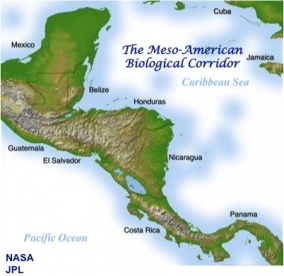
Mesoamerican Biological CorridorIn the 1990s, the eight governments of the region (Panama, Costa Rica, Nicaragua, Salvador, Guatemala, Belize, Honduras and Mexico) agreed to coordinate their efforts to prevent biodiversity loss and create a huge system of interconnected parks, reserves and wildlife corridors that seamlessly link North America to South America. The vision is for an immense biological corridor connecting the forests of southern Mexico to those in the rest of Central America, all the way down to the Panama Canal.

Originally called the "Path of the Panther" and promoted by the Wildlife Conservation Society and by Dr. Archie Carr, founder of the Caribbean Conservation Corporation (now called the Sea Turtle Conservancy) that protects sea turtles on Costa Rica's Caribbean Coast, the project was adopted in 1997 by Central America's governments and changed its name to the Mesoamerican Biological Corridor (MBC).

The scale of the undertaking is massive. So far, Costa Rica is the only country that has elected a strategy of working with community and environmental organizations to create a chain of local biological corridors, using tax incentives, preservation easements, education, decentralized administration, partnerships with international organizations, and outright land purchases. As a result, Costa Rica has experienced a higher level of success in establishing the MBC than other countries in Central America.
Nevertheless, environmental destruction by real estate developers presents a serious threat to the environment. Additionally, if overall funding from international agencies is diminished or discontinued in the near future, it could mean the death of the entire Central American biological corridor project.
Costa Rica Central-Southern Pacific biological corridor

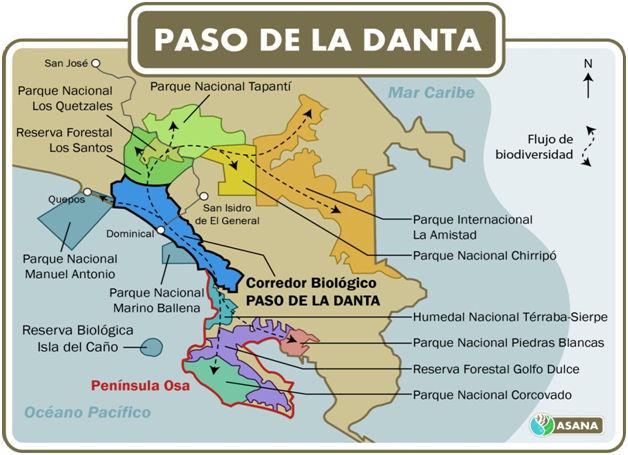
Pacific biological corridors Costa RicaA long chain of coastal mountains extends down Costa Rica's Central Pacific Coast to the Southern Pacific and the Osa Peninsula. These mountains also stretch inland up to the Cordillera Central (Continental Divide) that runs like a long spine from north to south down Costa Rica into Panama.

Here is one of Costa Rica's largest biological corridor projects. Private conservation organizations are working to link the Osa Peninsula Biological Corridor in the south with the Inter-oceanic Biological Corridor, which spreads from the Savegre River Valley in the Central Pacific to the central mountain range and La Amistad International Park into Panama. Included in this area are the Tapir's Path Biological Corridor near Dominical, the Rio Naranjo Biological Corridor and Portasol Biological Reserve, occupying the space between three of Costa Rica's most well-known national parks – Corcovado, Manuel Antonio, and Los Quetzales.
Portasol

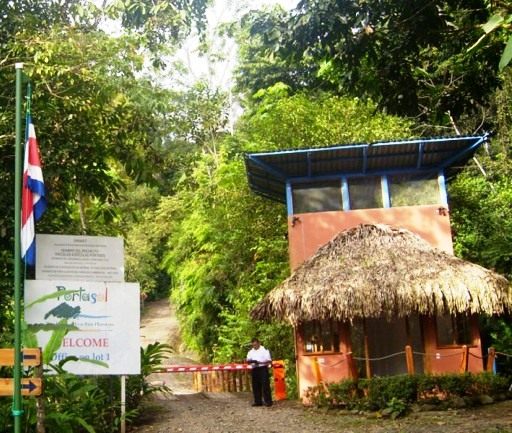
Portasol Rainforest & Ocean View Community entranceThe Portasol Biological Reserve is unique because it is part of the Portasol Rainforest & Ocean View Community land development. Real estate development and conservation of biological corridors might seemingly be juxtaposed, but in Portasol's case, they work in harmony.
"It is a radically different concept of real estate; very different from other private reserves in Costa Rica," remarks Olivier Chassot, Ph.D., land owner at Portasol and Executive Director of the Tropical Science Center in Costa Rica. "Portasol is a good example of what a green economy is. The value of Portasol is in the trees and rivers and animals, and not its houses or hectares."

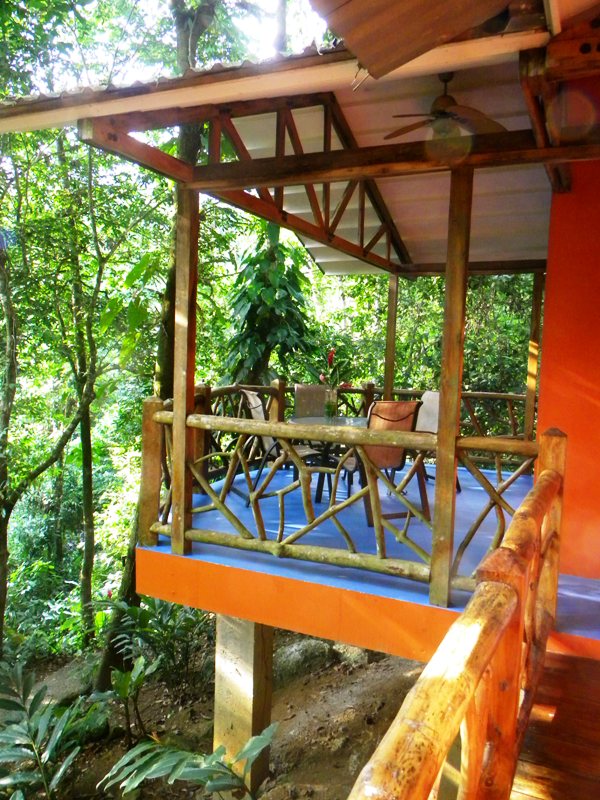
Vacation rental bungalow at Portasol Rainforest Community in Costa RicaPortasol is located in the coastal mountains half-way between Manuel Antonio and Dominical, right near Playa Matapalo and the Savegre River. Set on 1,300 acres of pure rainforest along the Portalón River Valley, the sustainable residential community has building lots for sale and also offers tourism hospitality with unique vacation rentals. Two hundred acres of virgin forest near the top of the mountain has been set aside as a private nature reserve. The development is part of the Inter-oceanic Biological Corridor.

"Portasol is important because it is perpendicular to the mountain range and the sea, in its widest part," explains Chassot. "Birds, insects, animals and trees can move in the corridor and adapt to climate change by moving up with the warming trend."
Chassot noted that Portasol has a good elevation gradient with many different ecosystems. "Portasol has a great potential for biodiversity because of its widely varied environment from flat land to high mountains, valleys, rivers, creeks and forest," he said.
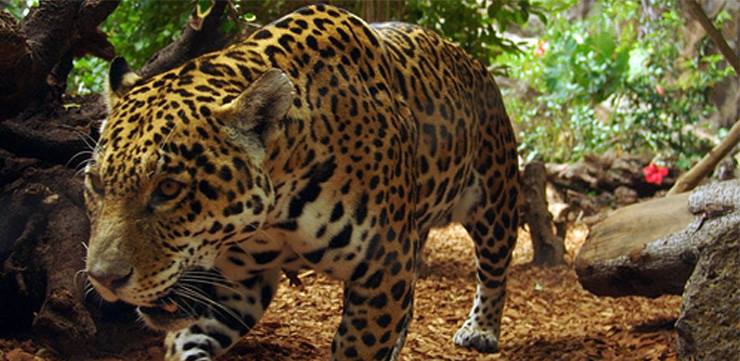
Jaguar in Corcovado National Park, part of Costa Rica's Pacific biological corridorChassot and his wife, Guisselle Monge Arias, Ph.D., both work with numerous conservation organizations in Costa Rica and Central America – the Tropical Science Center (one of the most influential institutions in Latin America in science and conservation), the Great Green Macaw Research and Conservation Project in Sarapiqui, the San Juan-La Selva Biological Corridor near Sarapiqui, and the Mesoamerican Society for Conservation Biology. They purchased a 1-hectare lot at Portasol in January 2013.
"We were really delighted by the forest environment," said Chassot. "We fell in love with the place. The sheer beauty is amazing … water everywhere, the trees. It's a real holistic development."
Portasol Rainforest Community river and forests are protectedChassot and Monge agree that Portasol is a model project on land use, offering large properties and a nationally registered ecological easement. The development has a rule that owners may only build on 15% of their land and must preserve the rest in green space. A conservation easement binds heirs and future landowners to comply with the easement's terms, ensuring that conservation purposes are met forever. Conservation easements were pioneered in the United States. Costa Rica, advised by The Nature Conservancy in the early 1990s, was the first country in Latin America to develop conservation easements and land trusts.
"We have been promoting ecological easements in our work," noted Chassot. "It is great that our neighbors will have to respect the terms of the easement and the land will be protected for our kids and grandkids, etc."
Added Monge: "There is much more awareness in Costa Rica today toward nature. People are thinking about preserving the natural resources of the country. Costa Rica is the most advanced nation in Central America in preserving its biological corridors."
By Shannon Farley

martes, 30 de abril de 2013

Educational programs focus on Costa Rica biodiversity

Summer school breaks are coming up for North America and Europe, and with that the opportunity for student groups to enjoy educational trips. The Neotropical rainforest of Costa Rica in Central America, part of one of the most important reserves of biodiversity on Earth, is fertile ground for study disciplines such as Ecology, Biology, Environmental Sciences, Animal Behavior, Zoology, Ornithology, Herpetology, Geography, Plant Sciences, and Land Economy, among others.
Logo from the European Commission Biodiversity CampaignThe study and sustainable preservation of biodiversity is vital to an enduring existence for humans and all life on the planet, according to Dr. Mike Rands, Executive Director of the University of Cambridge Conservation Initiative in England.
"Life on Earth is at risk from an unprecedented rate of environmental change that threatens the natural resources on which humanity depends. Biodiversity – the genes, species and ecosystems that comprise nature – provides food, fuel, medicines and other vital 'ecosystem services', along with countless intangible benefits, for society. But biodiversity is in steep decline, and its sustainable management is a major challenge for the 21st century," explains Rands.
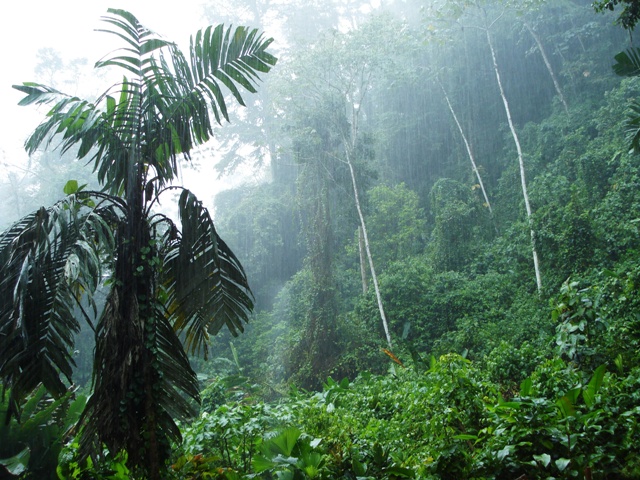
Neotropical rainforest at Veragua Rainforest Research & Adventure in Costa RicaThe Neotropics include more tropical rainforest than any other eco-zone, extending from southern Mexico through Central America and northern South America to southern Brazil, including the vast Amazon Rainforest (reference: Wikipedia). Veragua Rainforest Research & Adventure protects 1,300 hectares (3,212 acres) of tropical rainforest in the foothills of the Talamanca Mountain Range in Costa Rica, an hour inland from the Caribbean Coast and the port town of Limón. The biology research center and adventure destination borders the La Amistad ("Friendship") International Park, which is the country's largest and most remote national park shared by both Costa Rica and Panama.
Veragua's team of biologists work in partnership with the University of Costa Rica (UCR), Costa Rica's National Institute of Biodiversity (INBio), and the National Museum of Natural History to preserve the area's population of frogs, snakes, lizards, iguanas, insects, butterflies and birds.
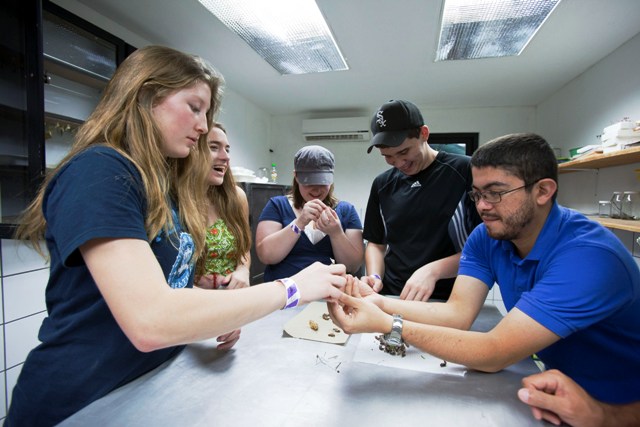
Veragua biologist Rolando Ramirez works with students on entomologyVeragua Rainforest offers an excellent educational opportunity for students and educators with hands-on research of rainforest life. The property contains a biology research station, wildlife habitats, walking trails through the rainforest, a river and waterfall, an aerial tramway, a canopy zip line tour, group accommodations, and a restaurant, café and souvenir shop. Ongoing research at Veragua is coordinated by University of Costa Rica biologists José Andrés Salazar and Rolando Ramírez. Salazar is a Herpetologist, and Ramirez specializes in Entomology.
Some examples of educational programs possible at Veragua Rainforest:
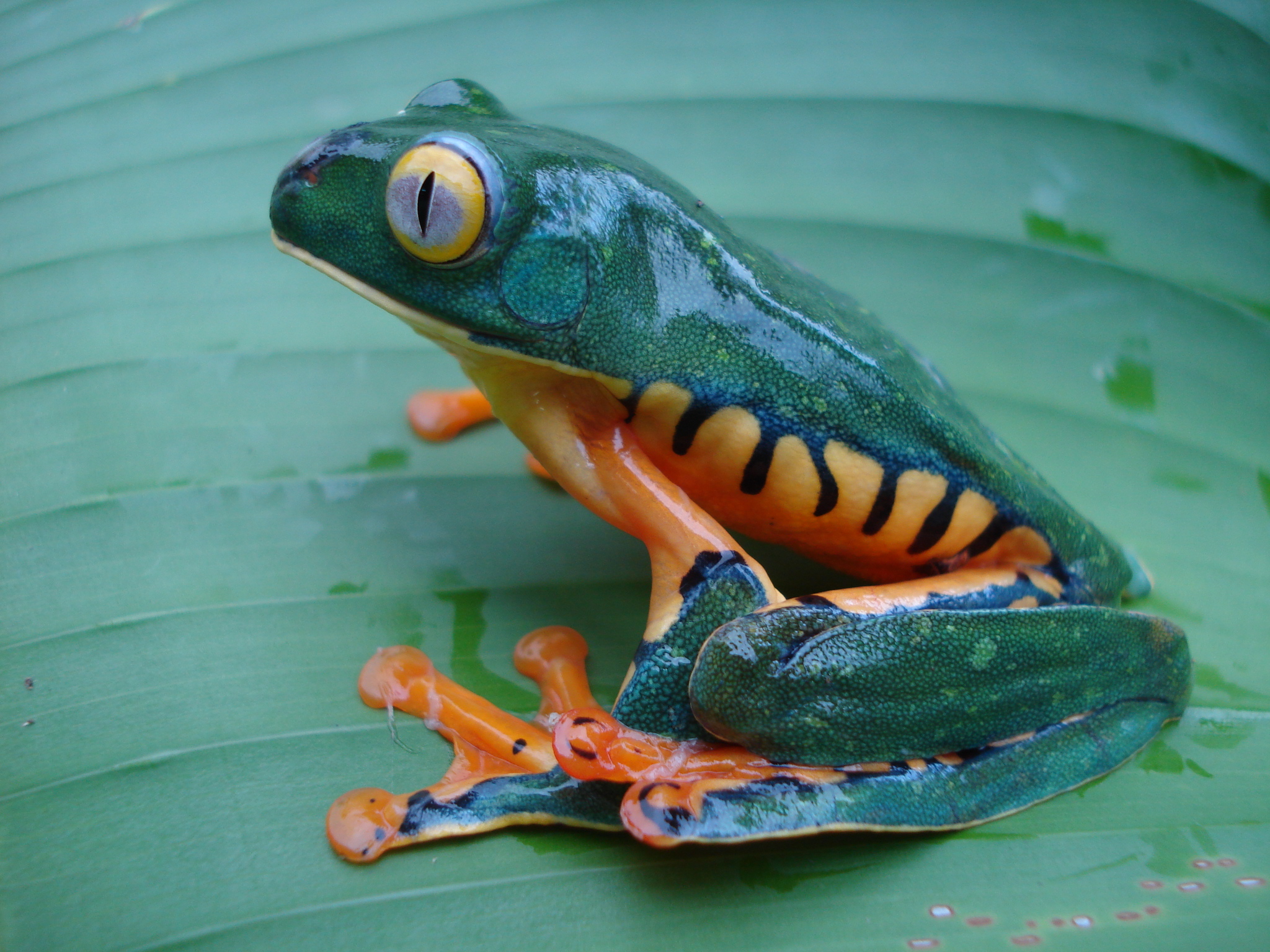
  • Veragua's Snakes, Frogs, Toads and Butterflies: Veragua Rainforest has at One of the many species of rainforest frogs at Veragua Rainforest in Costa Ricapresent identified 55 species of frogs, the greatest diversity in Costa Rica, according to Salazar. To help sustain the frogs and other species, Veragua has created artificial habitats with all natural elements so the animals can thrive and reproduce. Using natural plants, earth and water, it's as if they've taken a real section of the forest and put a bubble over it. Salazar and his team even created the planet's largest nocturnal frog exhibit. Students will work with resident biologists to learn relevant and interesting information (regions found, maximum size, eating habits, etc.) about the various species in the exhibits. Then they will go out into the rainforest to encounter animals in the wild, and to look for new species.
  • Butterfly and Beetle Trap Set-up: With Veragua's on-site biologist, students will go out into the field to set up insect and butterfly traps for future collection and identification.
  • Veragua Rainforest research center studies many species of Costa Rica butterfliesButterfly Garden Work: Students will work on activities such as garden maintenance, collecting eggs and wings, pupa box maintenance, pupa selection, releasing butterflies, butterfly garden feeding, and seed planting in the garden.
  • Owl and Insect Night Hike: Students get the chance to experience the rich sounds and unusual visuals of the rainforest at dark by going out onto the trails with Veragua's biologists. Students will discover nocturnal frogs, colorful insects, snakes, and possibly even nocturnal mammals such as the opossum or the kinkajou. Another fun activity for students is to identify the different characteristics of nocturnal insects and moths with the on-site entomologist.
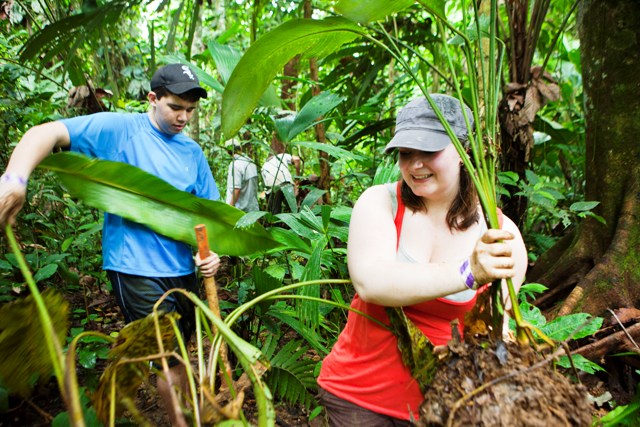
  • Students plant trees for the community near Veragua Rainforest in Costa RicaPeje School Community Work: Located 2 miles from the Veragua Rainforest entrance, the Peje School is the community's local elementary school. Students will interact with the school children on such activities as maintenance projects, English tutoring, tree planting and singing local songs with them.
Veragua Rainforest Research & Adventure offers educational program packages from 2 to 4 days, or longer. Accommodations are dorm-style with bunk beds sleeping 8 persons per room (6 dorm rooms); there is one double room with twin beds and private bathroom for teachers. Men and women have separate shared bathrooms with showers.
Veragua Rainforest Research & Adventure Park is an all-in-one total rainforest experience and not-to-be-missed when visiting Costa Rica's Caribbean area. Veragua Rainforest Research & Adventure is open to day visitors Tuesday to Sunday, from 8:00 am to 3:00 pm. Admission is $66 for adults and $55 for children/students; children under age 4 receive free admission. Veragua is located 40 minutes from Limon and 2 ½ hours from San José, in Brisas de Veragua, 12 km south from the Liverpool entrance on the highway to Limón.
By Shannon Farley