Mostrando entradas con la etiqueta Caribbean costa rica. Mostrar todas las entradas

viernes, 26 de diciembre de 2014

Fantastic sea turtle tours at Lirio Lodge in Caribbean Costa Rica

Green sea turtles nesting at Tortuguero

Thousands of visitors come to Costa Rica each year with the hope of witnessing the extraordinary phenomenon of seeing sea turtles nest and lay their eggs. These ancient reptiles have been swimming Earth’s waters for at least 150 million years, mysteriously returning to the same beach where they were born.

Leatherback sea turtle, image by Sea Turtle Conservancy
Costa Rica’s Pacific Coast beaches receive mass arrivals of female turtles by the tens of thousands, and the Costa Rica Caribbean beaches have crucial world nesting sites. Of the seven species of sea turtles that exist on the planet, four of them nest on the beaches of the Costa Rica Caribbean Coast.

Tortuguero National Park and its neighboring beaches of the northern Caribbean Coast of Costa Rica are recognized as the Western Hemisphere’s most important nesting site for endangered Green Sea Turtles (Chelonia mydas); and are a major nesting site for the critically endangered Leatherback (Dermochelys coriacea), Hawksbill (Eretmochelys imbricata), and Loggerhead (Caretta caretta) sea turtles.

Pacuare Matina Reserve on Northern Caribbean Costa Rica
Between the Caribbean port city of Limon and the Tortuguero National Park is the Pacuare-Matina Forest Reserve. This even more remote area than Tortuguero is also an important nesting site for Leatherback, Green and Hawksbill sea turtles.

It is like Tortuguero 20 years ago, before it was developed, with the same wetlands and lowland rainforest, lagoons, beaches, and turtles that come to nest,” noted Helberth Chavarria Madrigal, operations manager at Lirio Lodge, located next to the Pacuare-Matina Forest Reserve.

The Costa Rica eco-lodge specializes in nature tours and educational tourism. During turtle nesting season, which begins in March, Lirio Lodge offers turtle tours with their bilingual guides. The tour is at night when turtles typically come up on the beach, using the cover of darkness for protection from predators. The Costa Rica jungle lodge works with the local grassroots Association of the Pacuare Community that protects the turtles.


Lirio Lodge at Pacuare Costa RicaThe advantage of visiting the Pacuare-Matina Forest Reserve over Tortuguero is that turtle nesting season begins a few months earlier. Since the only place to stay is at Lirio Lodge, the area also is far less transited than the 50,000 tourists who come annually to Tortuguero for turtle nesting and hatching season, from June to October.

“At Lirio Lodge, we have far less people going to see the turtles. In Tortuguero, you might have 400 persons or more in one night, from all of the different lodges, out on the beach trying to see turtles. In our area, people on the tour are only people staying at our lodge,” commented Lirio Lodge co-owner Leo Jones.

For information on vacation packages, contact Lirio Lodge.

Article by Shannon Farley

Three beaches in the Costa Rica Southern Caribbean you have to visit

Caribbean Coast Punta Uva Costa Rica

Three of the prettiest beaches on the Southern Caribbean Coast of Costa Rica are Playa Cocles, Playa Chiquita and Punta Uva. That is if you like long stretches of gorgeous picture postcard Caribbean coastline with warm turquoise ocean and graceful tall palm trees. When you are on the beach on the Costa Rica Southern Caribbean Coast, all you see are sea, sand, sky, trees … and maybe the occasional other person or pretty tropical bird or monkey.

There are no high-rise mega-resorts or unending rows of condos like on many of Costa Rica’s Pacific beaches. Here, everything blends in harmony with the rainforest.

Playa Chiquita Costa Rica

Playa Cocles begins 1.5 kilometers (just under a mile) south of Puerto Viejo Costa Rica , a funky beach town and “capital” of the Southern Caribbean region of Costa Rica. Its soft golden beach stretches 3 kilometers (1.8 miles) to Playa Chiquita. There are trails that hug the beach passing under giant trees, past bright tropical flowers, sea grapes and lots of greenery. Watch for monkeys, colorful tropical birds, sloths, green iguanas and crabs.

Beach trail by Playa Cocles, Costa Rica Southern Caribbean

Playa Cocles is a top Caribbean Costa Rica beach for surfing and boogie boarding. For lovers of the underwater world, the Southern Caribbean has some of the best coral reefs and marine life in Costa Rica. Coral reef extends along the coast from the Cahuita National Park to the Gandoca-Manzanillo Wildlife Refuge

The picturesque beaches of Playa Chiquita and Punta Uva, just past Playa Cocles to the south, are also excellent for snorkeling.

Coral reefs Costa Rica Southern Caribbean

La Sula Sea Lounge of Hotel Le Caméléon is one of the best places to relax on Playa Cocles. Lounge on a day-bed by the sea. Sip a refreshing tropical drink from the bar and have a light snack, before grabbing a siesta in one of the hammocks under a palm tree.

Beach Club Hotel Le Cameleon

The upscale Costa Rica boutique hotel at Playa Cocles features ultra-chic rooms and beautiful tropical architecture in lush jungle gardens; the elegant Le Numu Restaurant & Bar is one of the area’s top restaurants.

Le Cameleon Hotel room, Caribbean, Costa Rica

Getting to the Southern Caribbean of Costa Rica and Playa Cocles is now easier than ever with a new 30-minute flight by Nature Air between San Jose and Limon. Hotel Le Caméléon is offering a three-night vacation package until Mar. 27, 2015 that includes round-trip flights on Nature Air, accommodation, some meals, VIP access to the La Sula Sea Lounge, and a tour to the Jaguar Rescue Center.
 Article by Shannon Farley

lunes, 1 de diciembre de 2014

Educational tourism at Lirio Lodge in Costa Rica helps community

Students canoeing at Lirio Lodge Costa Rica

Educational tourism
is one of the fastest growing areas of travel and tourism. Not just for students, educational travel is about learning and being involved in community action projects while traveling and relaxing on vacation.
Costa Rica offers a wide variety of educational travel and volunteer opportunities for people of all ages. An excellent destination for educational tourism and volunteer groups is Lirio Lodge by Tortuguero in Costa Rica.
Lagoon by Lirio Lodge Costa RicaThe Costa Rica eco-lodge is located in an area of the northern Caribbean Coast, between the port city of Limon and the Tortuguero National Park, where the famous whitewater rafting river, the Pacuare, meets the Caribbean Sea.
It is like Tortuguero 20 years ago before it was developed, with the same wetlands and lowland rainforest, lagoons, beaches and turtles that come to nest,” noted Lirio Lodge operations manager Helberth Chavarria Madrigal.
Lirio Lodge location in Costa RicaThe closest community of Pacuare Sur (South Pacuare) is tiny with maybe 100 persons in residence. The area is surrounded by water between the ocean, the Pacuare River and the immense Mother of God Lagoon (named after the “Madre de Dios” river that forms it).
The community here is very poor. There is no electricity. There is only one classroom with one professor for 10 students, each in different grades. And this one professor must give classes to all of them. He has to travel 25 kilometers each way every day to teach; one hour by bus and 15 minutes by boat each way,” Chavarria explained.
Resources in the community are precious and meager, he said. For this reason, Lirio Lodge focuses on Costa Rica educational tourism to bring student groups to the Costa Rica jungle lodge both to experience and learn about the amazing nature of the area, and to contribute to the community with betterment projects.
“When groups ask us for volunteer projects, we try to help the community and the school as much as we can,” said Chavarria.
Lirio Lodge Costa RicaLirio Lodge primarily receives groups of university students who are in Costa Rica on language study programs for several months. The students come to the lodge on weekends to do community work. Among the community improvements educational tourism students have made are: building a dining room for the school, constructing dry pathways above the swamp mud to the school entrance, creating gardens, cleaning up trash, building a new bathroom for the school, and improving the school’s water storage and usage.
Lirio Lodge offers one-day tours, and a two-day-one-night package with boat and hiking tours, lodging, all meals and roundtrip transport from San Jose.
Article by Shannon Farley

jueves, 19 de diciembre de 2013

Birders in the Americas join in 114th Christmas Bird Count.

For more than 100 years, every year at Christmastime, rather than searching for the perfect present, tens of thousands of active passionate folks explore the great outdoors looking for the most splendid birds.
Outfitted with binoculars, bird guides and checklists, birding devotees throughout the Americas brave snow, wind, rain, or maybe even tropical sun, to take part in the Christmas Bird Count. The National Audubon Society of the USA and other organizations use data collected in the annual Christmas Bird Count to assess the health of bird populations, and to help guide conservation action.

This year, the 114th annual Christmas Bird Count in the United States is from Dec. 14 through Jan. 5. Down in the tropics, Costa Rica also participates in the Christmas Bird Count. This year, the count began Dec. 1 at Selva Verde Lodge in Sarapiqui, and ends Jan. 5 near San Carlos, with nine other counts in between at locations around the country.

Last year, the highest number of birds counted in Central America was in Costa Rica. A record number of 417 different bird species, and 12,665 individual birds, were identified in a 24-hour period on Dec. 5 in the Central Caribbean by Veragua Rainforest.
Male Shining Honeycreeper at Veragua, photo by Patrick O'DonnellAccording to avid Costa Rica birder and blogger, Patrick O’Donnell, local birders rave about the excellent birding at Veragua Rainforest. O’Donnell’s Costa Rica Living and Birding blog provides a wealth of information about bird watching in Costa Rica.

Veragua Rainforest Eco-Adventure is a 1,300 hectare (3,212 acre) biology research and rainforest adventure park located in the Talamanca Mountain Range about an hour inland from Costa Rica’s Caribbean port of Limón. It is an area of breathtaking tropical rainforest bordering the La Amistad (“Friendship”) International Park, the largest nature reserve in Central America. Veragua Rainforest is an excellent one-day tour in the Costa Rica rainforest to enjoy wildlife exhibits, science labs, and adventure tours.

Travel Tip: Download the Costa Rica Birds Field Guide, a full-featured birding field guide for Costa Rica, available on iTunes.
Article by Shannon Farley

martes, 19 de noviembre de 2013

45 new butterfly species discovered in Costa Rica.

In the case of butterflies, it pays to look like your neighbor.

New information about long-winged butterflies in Costa Rica is showing how the importance of "mimicry" and theTwo species of Heliconius butterflies, image by Marcus Kronforst, University of Chicago butterflies' natural promiscuity has led to interbreeding and the creation of new species that look very much alike, according to a study led by University of Chicago evolutionary biologist, Marcus R. Kronforst.

"In evolutionary biology, mimicry is the similarity of one species to another which protects one or both.This similarity can be in appearance, behavior, sound, scent and location, with the mimics found in similar places to their models," notes Wikipedia.

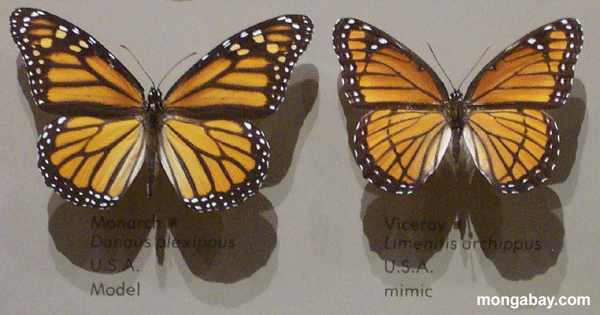
Mimicry, or looking like another, is important to butterflies to avoid being a tasty snack for birds and other predators. If a tasty or non-venomous butterfly is confused with a bad-tasting or toxic butterfly, both species will go unmolested and be more likely to survive.

Butterfly mimics Monarch on left and Viceroy on rightTake, for example, the Viceroy butterfly (Limenitis archippus) which mimics the Monarch Butterfly (Danaus plexippus) in shared orange and black coloration patterns. While the Viceroy butterfly isn't incredibly appetizing to birds, it is not highly toxic like the Monarch; yet because they look alike, predators tend to leave both alone.

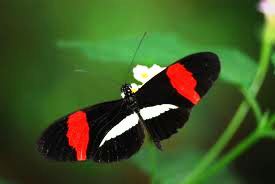
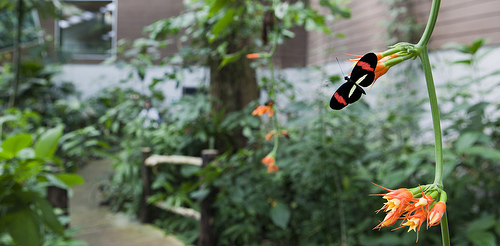
The long-winged Heliconius butterflies are the species in the study whipping up interest. The butterflies, including one known as the "Costa Rican postman," have bright orange markings on their wings and are toxic. Promiscuous habits have led to the creation of up to 45 new species from the butterflies' interbreeding, scientists report. The interesting thing the geneticists have discovered is that all of the species resemble one another (Mullerian mimicry) with slight differences, which has led to shared survival tactics by baffling predators into avoiding a range of wing patterns.

Butterfly HeliconiusApproximately 17,500 species of butterflies exist in the world, according to the Smithsonian Institute. Costa Rica is home to about 1,251 species of butterflies and at least 8,000 species of moths, cites Wikipedia.

The Butterfly Garden at Veragua Rainforest Research & Adventure, in Costa Rica's Caribbean rainforest, is inhabited by some of the most colorful butterflies in the world, including the noteworthy Heliconius butterflies. A tour at the 1,300 hectare (3,212 acre) biology research center and adventure park lets you walk through an immense live butterfly garden, plus visit a research lab where staff scientists study the behavior and lifestyle of these vivid flying insects.

Butterly garden at Veragua RainforestVeragua Rainforest Research & Adventure is located in the Talamanca Mountain Range about an hour inland from Costa Rica's Caribbean port of Limón. Veragua Rainforest is an excellent one-day tour in the Costa Rica rainforest. Attractions include wildlife exhibits and science labs, an aerial tram, canopy zipline tour, rainforest hiking trails, a river with waterfalls, and a restaurant, café and souvenir shop.
Article by Shannon Farley

lunes, 28 de octubre de 2013

Can agriculture co-exist with rainforest in Costa Rica's Caribbean lowlands?

Evidence shows that Costa Rica's 17-year-old deforestation ban on cutting "mature" forests may actually be working, according to a study published recently in the journal Environmental Research Letters.

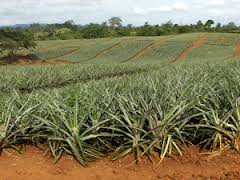
Pineapple plantation in Costa Rica's Caribbean lowlandsIn Costa Rica's northern Caribbean lowlands, in an area where pineapple production tripled over the past decade, a study led by Matthew Fagan of Columbia University found that the annual loss rate of old-growth forest dropped 40 percent despite the region's agricultural boom. Researchers used satellite imagery to determine whether deforestation has been happening to make way for pasture and cropland in the area since the 1996 law was enacted.

"We observed that following the ban, mature forest loss decreased from 2.2% to 1.2% per year, and the proportion of pineapple and other export-oriented cropland derived from mature forest declined from 16.4% to 1.9%," the researchers wrote. "The post-ban expansion of pineapples and other crops largely replaced pasture, exotic and native tree plantations, and secondary forests."

What appears to be happening is that the primary industrial agricultural crops in the region – pineapples and bananas – have shifted to taking over pastureland and non-protected green areas. Mature forests are being protected for the most part; however, there is still not an ecological solution to the agriculture vs. rainforest issue.

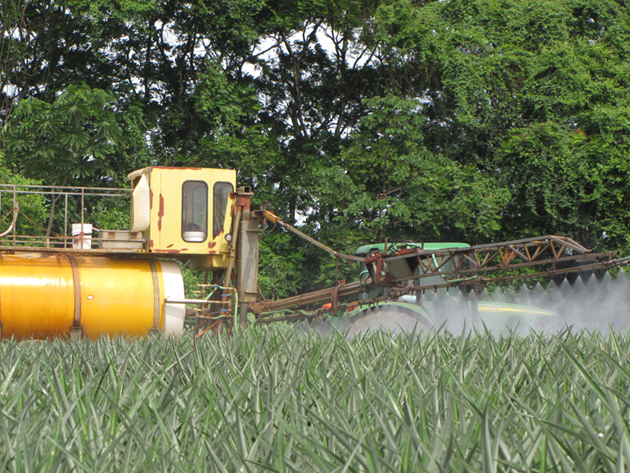
Spraying pineapple fields by forest in Costa RicaThe researchers note that intensive agriculture has taken over important non-protected forests, including wetlands and secondary forests, and that their use of agricultural chemicals puts animals and aquatic habitats at risk. Additionally, they observe that these monocultures offer fewer habitats for wildlife than, for instance, a typical cattle pasture, which usually includes scattered tree cover that can be used by many species. A pineapple farm, on the other hand, is usually devoid of trees and in effect is a biological desert.

"Pineapple and banana production in Costa Rica depends on extremely high applications of fertilizer and toxic pesticides," the study's authors write. "In Costa Rica these agro-chemicals have degraded water quality and disrupted downstream ecosystems, and contaminated forests with pesticides."

Forests and coffee production

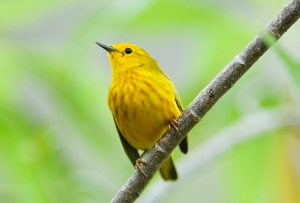
Protecting coffee farms from pests is the yellow warbler, image by Nature JournalPineapple-producing companies could perhaps learn a lesson from Costa Rica's coffee farmers, who have found that the more trees their farms have, the more birds live in the area and help reduce pest infestations.

 According to a study reported in the Nature Journal, insect-eating birds reduced damage from a devastating coffee pest, the coffee berry borer beetle (Hypothenemus hampei), by about half. The African borer beetle is invulnerable to most pesticides, and can cost farmers up to 75% of their crop.

"Based on this study, we know that native wildlife can provide you with a pretty significant benefit," states Daniel Karp, a conservation biologist at Stanford University in California, who led the study. "Incorporating their conservation into your management of pests is absolutely something you should do."
Costa Rica's success with reforestation

Costa Rica is the first tropical country in the world that has reversed a decades-long process of deforestation – dropping from 85% forest in 1940 to 35% forest by 1980. According to a 2012 World Bank report, Costa Rica was back up to 51.02% forest in January 2010.

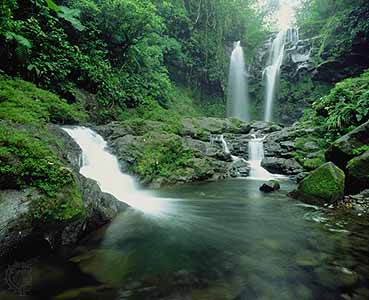
Costa Rica lush rainforestDeforestation and forest degradation, through agricultural expansion, conversion to pastureland, development, destructive logging, fires, etc., account for nearly 20% of global greenhouse gas emissions.

 That is more than all of the transportation on the planet, and second only to the energy sector, according to the United Nations Collaborative Program on Reducing Emissions from Deforestation and Forest Degradation in Developing Countries (UN-REDD).
Luckily for Costa Rica, the big business of ecotourism has become an important revenue source and is pushing reforestation and greater environmental protection measures.

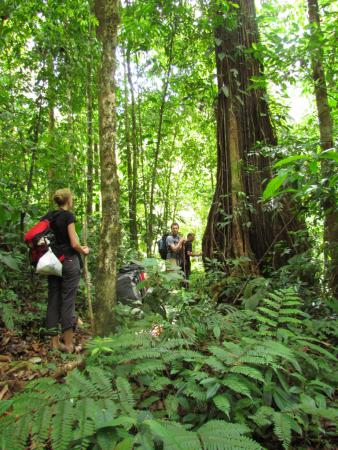
Hiking in the rainforest at VeraguaAn exemplary conservation project in Costa Rica's Caribbean mountains is Veragua Rainforest Research & Adventure Park. "We're a perfect example of an ecotourism project," says Veragua owner Marti Jimenez. "We're located in a poor area that traditionally was involved in logging, mono-agriculture and hunting. We're turning the region into a conservation-focused area, giving locals jobs and teaching them to protect their resources."

Veragua Rainforest is a 1,300-hectare (3,212-acre) biology research center and adventure park, located about an hour inland from the historic Caribbean port town of Limon. It is an area of breathtaking tropical rainforest next to the Talamanca Mountain Range and the La Amistad ("Friendship") International Park.

 Visitors have a complete Costa Rica rainforest experience in a one-day tour at Veragua. The park is a principal day tour for cruise line passengers docking in Limón. Attractions include wildlife exhibits and science labs, an aerial tram, canopy zipline tour, hiking trails, a river with waterfalls, and of course, the rainforest.

Article by Shannon Farley