Mostrando entradas con la etiqueta Costa Rica rainforest lodge. Mostrar todas las entradas

jueves, 11 de febrero de 2016

Explore The Costa Rica Rainforest With Expert Scientists

Untitled Document

Playa Nicuesa Rainforest Lodge in Costa Rica

What’s better than being in the rainforest? Being in the rainforest with expert scientists who can tell you fascinating stories about the animals and plants that live there.

Playa Nicuesa Rainforest Lodge in Costa Rica has invited celebrated U.S. scientists Howard Topoff, Ph.D. and Scientists Howard Topoff & Carol SimonCarol Simon, Ph.D. – both professors’ emeriti of The City University of New York and former Research Associates at the American Museum of Natural History – to be special guest lecturers at the award-winning Costa Rica eco-lodge from March 22 to 28, 2016. Scientist Howard Topoff

The husband-and-wife team specializes in animal behavior, tropical ecology and evolutionary biology. For the past 30 years, Drs. Topoff and Simon have been study trip leaders for The Smithsonian Institute, The American Museum of Natural History, Naturalist Journeys, Elderhostel, and several cruise lines. This will be the third year that they will lead an educational travel program at Playa Nicuesa Rainforest Lodge. Dr. Topoff has spent over 40 years researching the social behavior of animals in Central and South America, Africa, and in the deserts and mountains of Arizona, USA. In addition to his publications in scientific journals, his popular articles have appeared in magazines such as National Geographic, Scientific American and Natural History.

His research has been featured on National Geographic Television and Scientific American Frontiers. Dr. Simon specializes in ecology, behavior and evolution, principally researching the social behavior of reptiles in North and Central America.   Playa Nicuesa Rainforest Lodge offers a unique and exotic destination for the exciting six-night educational program. The flagship sustainable tourism eco-hotel in Costa Rica is located on 165 acres of private tropical rainforest preserve – accessible only by boat on the Pacific gulf of Golfo Dulce. The area is part of an immense biological corridor including the famous Corcovado National Park on the Osa Peninsula and the Piedras Blancas National Park – some of the most biologically diverse places on Earth.

Scarlet Macaws at Playa Nicuesa Rainforest Lodge

You will be surrounded by toucans, Scarlet Macaws, monkeys and other amazing wildlife in the lush Costa Rica rainforest and Pacific Ocean. With expert guides, you will spend your days exploring the surrounding forests for wildlife of all forms. In the evenings, Drs. Topoff and Simon will entertain you with fascinating multimedia presentations providing in-depth insights into what you have been seeing in the field.

Squirrel Monkeys in Costa Rica

Some of the interesting topics you will learn about include:

  • Introduction to the Rainforest of Costa Rica
  • Primates of the New World Tropics
  • Venomous Amphibians and Reptiles of the Rainforest
  • Butterflies of the Tropics
  • Natural History of Rainforest Social Insects
  • Bird Brains: Sensory Basis of Bird Behavior
  • Animal Coloration
  • The Evolution of Animal Communication
  • Mating Strategies of Animals
  • Introduction to Tropical Plants

Join Drs. Topoff and Simon in a week of exploration of tropical biodiversity at eco-friendly Playa Nicuesa Rainforest Lodge in Costa Rica from March 22 to 28, 2016. Check here for reservations in Nicuesa Lodge’s comfortable accommodations.

Playa Nicuesa Rainforest Lodge in Costa Rica

To get to Playa Nicuesa Rainforest Lodge: drive or fly (Nature Air or Sansa Airlines) to either Puerto Jimenez or Golfito in southern Costa Rica. Nicuesa Lodge will pick you up by boat and transfer you to the lodge (about 30 minutes). Included in lodge rates are all meals and snacks, boat transfers, taxes, and unlimited use of rainforest hiking trails, kayaks, snorkeling and fishing equipment. Be sure to try their adventure and nature tours, and the beautiful yoga deck by the beach. Article by Shannon Farley

viernes, 26 de junio de 2015

Reforestation & carbon neutrality at Costa Rica eco lodge Playa Nicuesa

Costa Rica rainforest at Nicuesa LodgeCosta Rica is a small country with a big success story in reforestation.
The Central American nation was nearly devastated by deforestation by the early 1980s. Now more than 30 years later, over 52 percent of Costa Rica’s land is covered with forest between national parks, private reserves and wildlife refuges.

Costa Rica’s progressive reforestation and environmental protection earned the country the accolade of being named the third best Green Country in the World in the 2014 Global Green Economy Index™ (GGEI).

In southern Costa Rica on the Golfo Dulce (“Sweet Gulf”), eco-friendly Playa Nicuesa Rainforest Lodge is doing its part to help reforest Costa Rica. The Costa Rica eco-lodge protects 95% of their 165-acre rainforest property in an undeveloped and natural state. They began a reforestation program in 2010 to slowly remove the cacao trees – from the former cacao plantation where the lodge is built – that were infected by the fungus Moniliophthora roreri, or “frosty pod rot”. Instead, they are planting trees native to Costa Rica and the local area.

Planting native trees helps re-establish the biological corridor for animals between the Piedras Trees - Espavel in Costa RicaBlancas National Park and the Golfito Wildlife Refuge that border either side of Playa Nicuesa Rainforest Lodge.
Nicuesa Lodge guests can take part in the reforestation program by planting a tree when visiting. Guests who plant a tree during their stay at the lodge receive a thank you certificate that includes a photo of the person planting the tree, their name, and the description of the tree planted with the scientific and common names.

So far, approximately 150 trees have been planted by hotel guests and staff: species like Cortez Amarillo (Tabebuia ochracea, Gold Trumpet tree), Roble de Sabana (Tabebuia rosea, Pink Trumpet tree), Cenizaro (Samanea saman, Rain Tree), Espavel (Anacardium excelsum, Wild Cashew tree), and Gallinazo (Schizolobium parahyba, Brazilian Fire tree), among others. Trees are obtained by donations and seeds harvested naturally from the forest.

“Last year, we accepted a donation of 50 Cenizaro starter trees from the Costa Rica Tourism Board (ICT). We also collect seeds from the forest on our property, germinate them and grow seedlings, which we then plant in an area we set aside for reforestation,” explained Natalia Solis, Sustainability Coordinator at Playa Nicuesa Rainforest Lodge. “This project invites and involves our guests to be part of a change that helps our environment and also helps offset the carbon emissions generated during their journey and visit to the lodge.”

Besides planting trees when you stay at Playa Nicuesa Rainforest Lodge, you can reduce the ecological impact on the planet generated by your trip by purchasing carbon credits that will be used to reforest land elsewhere in Costa Rica. The program supported by Nicuesa Lodge is with the Costa Rica National Forest Financing Fund (FONAFIFO).

Playa Nicuesa treehouse main lodge
Stay at a real Costa Rica Eco Lodge Playa Nicuesa Rainforest Lodge gardens

Playa Nicuesa Rainforest Lodge opened in April 2003
as one of the first true eco-lodges in Costa Rica. Operating now 12 years, Playa Nicuesa Rainforest Lodge holds the highest rating in the Certification for Sustainable Tourism Program (CST) by the Costa Rica Tourism Board (ICT). Playa Nicuesa recently received the important Ecological Blue Flag Award for the fifth time for having one of Costa Rica’s cleanest beaches. Additionally, Nicuesa Lodge is working to be certified a Carbon Neutral Business, and the lodge supports the Osa Campaign and the Nature Conservancy that protects the Golfo Dulce and Osa Peninsula region.

Contact Playa Nicuesa Rainforest Lodge to visit the unique nature and adventure travel destination.

Article by Shannon Farley

lunes, 25 de mayo de 2015

A tale of dreams and adventure: Beginning Playa Nicuesa Rainforest Lodge

Playa Nicuesa Rainforest Lodge in Costa Rica

Guests staying at Playa Nicuesa Rainforest Lodge always ask: how did the Costa Rica eco-lodge get started?

The question is a reasonable one given Nicuesa Lodge’s isolated location in southern Costa Rica. It is a wild place of dense steamy rainforest and tranquil ocean, intensely populated by thousands of species of tropical wildlife. Playa Nicuesa is a little crescent-shaped beach and small bay on the pristine Golfo Dulce – “Sweet Gulf” – a critical habitat for migrating Pacific Humpback Whales, dolphins and hammerhead sharks. The region is a giant conservation area including the world-famous Corcovado National Park on the Osa Peninsula, the Piedras Blancas National Park and three other private reserves.

Playa Nicuesa on Golfo Dulce from the air

What keeps Playa Nicuesa Rainforest Lodge so unique and private is that the lodge is accessible only by boat. Almost directly across the gulf from the town of Puerto Jimenez, Nicuesa Lodge’s 165-acre private preserve is backed by rugged mountains and wild jungle of the Piedras Blancas National Park. There are no roads, and there is no development.

Dolphins in Golfo Dulce
So, how did a high-end eco-lodge come to be in this pure, remote place?

lunes, 11 de mayo de 2015

A liquid sky of blue stars – bioluminescence in Costa Rica

Bioluminescence-in-Life-of-Pi-movie

One of my absolute favorite scenes in the 2012 movie “Life of Pi is when a huge glittering whale jumps out of a sparkling night sea behind Pi’s raft, everything around them glowing from amazing bioluminescence. Another favorite is the illuminated neon forest in the movie “Avatar.”

Bioluminescence in Avatar movie

Bioluminescence is most common in the tropics
. Walking along a tropical beach at night or sea kayaking after dark, especially the closer you get to the equator, you often can see sparkling lights in the water. It seems as if the ocean is a liquid sky of blue stars.

“Bioluminescence is the production and emission of light by a living organism as the result of a chemical reaction during which chemical energy is converted to light energy,” according to Science Daily.

Bioluminescent jellyfish Bioluminescence occurs in many marine animal species – bacteria, plankton, fish, jellyfish, squid and crustaceans. It also exists in some fungi, microorganisms and terrestrial invertebrates – think of fireflies and glow worms. Marine life depends on their bioluminescence for finding food, attracting mates and evading predators, according to Science Journal. Sometimes thousands of square miles of ocean shine with the light of bioluminescent bacteria or plankton. For instance, Puerto Rico is famous for its three bioluminescent bays.
In Costa Rica, bioluminescence is a frequent occurrence in the Golfo Dulce. This southern Pacific region of Costa Rica by the Osa Peninsula is full of amazing biodiversity. Golfo Dulce is a critical habitat for migrating Pacific Humpback Whales, dolphins and sea turtles.

Bioluminescence in the ocean

A good place to see bioluminescence in Golfo Dulce
is at Playa Nicuesa Rainforest Lodge. On a non-rainy night when the sky is really dark with no moon, or enough clouds to hide any moon, walk down to Nicuesa Lodge’s boat dock to see if you can observe any bioluminescence in the sea. The water glows more when the microorganisms in it are agitated, so if it is a bioluminescent night, ask the guides to take you out in the kayaks for a paddle close to shore.

Playa Nicuesa Lodge in Costa RicaWhen you sea kayak in the illuminated water, every paddle stroke is like fireworks. Why the lights appear blue and green is because those are the light wavelengths that can transmit most easily through seawater, reports Science Daily. Sometimes you might even see dolphins eerily glowing in the bioluminescent water.

About Playa Nicuesa Rainforest Lodge

Playa Nicuesa Rainforest Lodge recently received the Ecological Blue Flag Award for the fifth time for having one of Costa Rica’s cleanest beaches. Bordering the Piedras Blancas National Park, the Costa Rica rainforest lodge holds the highest Sustainable Tourism Program rating, and offers nature tours in the rainforest and ocean adventure tours around Golfo Dulce.

Article by Shannon Farley

sábado, 28 de febrero de 2015

A dolphin tale: See wild dolphins in Golfo Dulce, Costa Rica

Bottlenose Dolphin, Golfo Dulce, photo by Earthwatch

The last time I was at Playa Nicuesa Rainforest Lodge, I was down at the beach cooling off from the hot sun in waist-deep tranquil waters of the Golfo Dulce, when suddenly there was a splash very close behind me. I turned quickly to look out toward the Gulf and was greeted by three Bottlenose Dolphins calmly gliding about 15 feet past me parallel to the beach.

This is how it is on Golfo Dulce in southern Costa Rica. Humpback Whale mother & baby in Golfo DulceDuring whale-watching season, you might see a Humpback Whale mother and her calf just offshore. Almost always will you see dolphins when you go on a boat tour of the Golfo Dulce or kayaking in the mangroves of the Esquinas River.

This area of pristine tropical wilderness by the Osa Peninsula is home to resident and migratory communities of Bottlenose Dolphins (Tursiops truncatus), Spotted Dolphins (Stenella attenuata), Spinner Dolphins (Stenella longirostris), and occasionally-seen False Killer Whales (Pseudorca crassidens). Every August when whale-watching season begins in Golfo Dulce, endangered Pacific Humpback Whales migrate to Costa Rica’s warm waters to breed and give birth. Golfo Dulce is a critical habitat for marine life, states the Center for Cetacean Research of Costa Rica (CEIC).
Dolphins in Golfo Dulce Costa Rica

The Gulf’s calm and very clear jade green-blue water makes it easy to see abundant marine life. Spotted Dolphins are some of the most common dolphins to see, whether in small pods in shallow inshore waters or huge groups of up to 500 dolphins offshore in deep ocean.
Bottlenose Dolphins in Costa Rica, photo by CEIC

Bottlenose Dolphins
stay close to river mouths, using the tidal cycles to catch fish. Golfo Dulce Bottlenose Dolphins are very social and are frequently seen in pods of two to 15 dolphins. Spinner Dolphins, as is obvious from the name, are known for spinning vertically out of the water on their tails.


When you stay at Costa Rica eco-lodge Playa Nicuesa you can see dolphins, whales and other marine life in Golfo Dulce. The luxury Costa Rica rainforest lodge has its own 165-acre private rainforest preserve bordering the Piedras Blancas National Park. It is a unique Costa Rica adventure travel destination for its remote, pristine wilderness location.

Article by Shannon Farley Sunset at Playa Nicuesa

miércoles, 11 de febrero de 2015

People need nature. See why in the Costa Rica rainforest.

Osa Peninsula, photo by Audubon Magazine 

“Nature doesn’t need people. People need nature,” is the message from Conservation International. The environmental organization’s widely popular video campaigns use famous actors’ and actresses’ voices with beautiful video footage of nature in two-minute messages to promote their important manifesto:
“Human beings are part of nature. Nature is not dependent on human beings to exist. Human beings, on the other hand, are totally dependent on nature to exist.”

In Conservation International’s “Nature is speaking” videos, the pervading missive is “the only way to save ourselves is to listen to nature.” “If they don’t figure out that they are a part of nature, instead of just using nature, they won’t be around,” cautions actor Robert Redford, speaking as a redwood tree about humans.


“One way or another, every living thing here needs me,” advises actor Harrison Ford in Conservation International’s video about the ocean. “It’s not their planet anyway. Never was. Never will be … if nature isn’t kept healthy, humans won’t survive.

Simple as that.” Playa Nicuesa, Golfo DulceThere is a video about the crucial importance of coral reef on the planet, and a dramatic chilling message about not ever eating again if humans keep destroying the soil. There is a lighthearted video on beautiful flowers and their key role in nature, and a harbinger of doom about water and the power of the oceans. The rainforest is our source for wood, medicinal plants, escape, and most importantly, air. Julia Roberts as Mother Nature tells us that she does not need us, but rather we need her. Roberts’ narrative sums up the significance: “Some call me nature.

Others call me ‘Mother Nature.’ I’ve been here for over 4.5 billion years – 22,500 times longer than you. I don’t really need people, but people need me … when I thrive, you thrive. When I falter, you falter, or worse.”


You can take action to join nature
and see the ocean, the Costa Rica rainforest , soil, flowers, rivers and coral reef in Mother Nature’s entire splendor at Playa Nicuesa Rainforest Lodge in Costa Rica. The extraordinary Costa Rica eco-lodge is located on a 165-acre private preserve on the Golfo Dulce (“Sweet Gulf”) in southern Costa Rica. The sustainably-designed property borders the Piedras Blancas National Park and the Osa Peninsula.

Article by Shannon Farley

sábado, 31 de enero de 2015

Costa Rica eco-lodge ready for reforesting 20 million hectares of Latin America

Great news for our country and Latin American forests: Costa Rica joins six countries in pledging to reforest 20 million hectares of Latin America.

Costa Rica continues to make news around the world. What a best way to start the year with such great news, not only for our beautiful country but for all of Latin America.

It turns out that Costa Rica among other 6 Latin American countries  (Mexico, Peru, Guatemala, Colombia, Ecuador and Chile) have commited themselves, and according to AFP reports, in pledging to reforest 20 million hectares – about the size of Uruguay – of degraded land by the year 2020. This statement was made during the 12-day talks amongst the world’s nations taking place in Peru under the UN Framework Convention on Climate Change (UN FCCC).

It is of great importance for all of these nations to commit themselves into such a responsibility that will make the whole world become even more aware of the actual climate changes and damage it has been resulting due mainly because of deforestation.

This group, now known as the “20×20 Initiative, has come to the following hectare amounts each:
Costa Rica and Chile: 50.000 hectares each.
Mexico 8.5 million hectares
Peru 3 .2 million hectares
Guatemala 1.2 million hectares
Colombia 1 million hectares


The Ecuadorian Minister of Environment, Lorena Tapia, expressed that  "with funding and support from the national government we will succeed in restoring 500,000 hectares by 2017" during the meeting in Lima, Peru.

As for Costa Rica interests, according to Mr. José Joaquín Campos director of the Tropical Agricultural Research and Higher Education Center (Catie), its main priority is  to reestablish the lands of Puriscal, Turrialba and some of Guanacaste´s zones.  In order to achieve this, Mr. Campos mentions that it will be necessary to have a joined work with the Ministry of Environment and Energy (Minae).

It is hoped that all this effort doesn´t stay only on paper and that the people involved will accept the challenge and assume their responsibility. In this way, not only our most important natural resources will benefit but also our next generations for years to come.

Green tourism, also called eco-tourism and sustainable travel, is what Playa Nicuesa Rainforest Lodge in Costa Rica is all about. The Costa Rica eco-lodge by the Osa Peninsula is one of only three dozen hotels in Costa Rica that have received the highest rating in the Certification for Sustainable Tourism Program (CST). Created by the Costa Rican Tourism Board (ICT), the CST program rates and certifies tourism businesses based on their compliance with natural, cultural and social resource management.

Playa Nicuesa sustainability highlights:
  • Lodge buildings are located on less than 2% of property – 98% is a private protected area.
  • Used recycled construction materials, such as: roof tiles on the lodge and cabins made from recycled plastics, including banana bags.
  • Wood came from naturally fallen trees, permitted by the government to be pulled out of the forest by oxen, or from farmed trees.
  • Electricity is provided by solar energy. Panels are located on main lodge structure. Back-up generator runs on recycled vegetable oil.
  • Solar drying room used to dry all of the lodge wash.
  • Hot water is provided by on-demand propane which means that the propane is used only when the hot water faucet is turned on.
  • Received the Ecological Blue Flag Award for clean beaches.
Article by Gabriela Serrano.

jueves, 4 de diciembre de 2014

Win a trip to Playa Nicuesa Rainforest Lodge in Costa Rica with cookbook photo contest

Whenever I travel anywhere that serves delicious meals, I always think, “How can I recreate this at home and enjoy it again?”
Edible Landscape Cookbook at Nicuesa LodgeIn the case of Playa Nicuesa Rainforest Lodge in Costa Rica, now I can. The Costa Rica rainforest lodge by the Osa Peninsula has released a free PDF downloadable Edible Landscape Garden Cookbook with a collection of 38 of their most popular recipes.
Read any of the TripAdvisor reviews about Playa Nicuesa Rainforest Lodge and guests always mention the delicious fresh meals, tropical fruit and creative cocktails. Now you can create a little bit of tropical paradise right in your own kitchen.
“Playa Nicuesa Rainforest Lodge was conceived in 2003 as a place where visitors would enjoy an intimate experience with the natural wonders of the Costa Rica rainforest and the Pacific Ocean, while enjoying an adventurous and sustainable vacation.

Guests enjoyed our fresh and locally-sourced food so much that our family-style meals soon became a central part of the Nicuesa Lodge experience. More and more guests would ask us for our recipes to take home with them, and so was born the idea for our Edible Landscape Garden Cookbook,” write Nicuesa Lodge owners in the book introduction. “Our recipes became a clear reflection of Nicuesa’s overall philosophy: authentic, fresh, natural, fun and sustainable.”
Edible Landscape Photo Contest at Nicuesa LodgeYou can even enter a photo contest based on the new cookbook to win a four-night vacation for two persons at the Costa Rica eco-lodge.
The photo contest is easy. Simply download the new Edible Landscape Garden Cookbook from Playa Nicuesa Rainforest Lodge, and prepare any recipe you wish from the collection. Snap a fun photo of you, your family and/or friends enjoying the delicious dish and submit your photo on Nicuesa Lodge’s Facebook photo campaign page.

Then tell all of your friends to vote for your photo. The photo with the most votes by Dec. 15 wins!
The winner will receive a four-night stay for two persons in a double Mango Guesthouse roomsRoom in the Mango Guesthouse at Playa Nicuesa Rainforest Lodge with all meals, unlimited use of kayaks, snorkeling gear and fishing equipment, self-guided hikes throughout the 165-acre preserve, and boat transfers between the lodge and either Golfito or Puerto Jimenez.

The stay at Playa Nicuesa Rainforest Lodge is valid between May 1, 2015 through September 30, 2015, or November 16, 2015 through December 15, 2015 (all dates subject to availability). See the official rules on the Facebook page for more details.
You definitely don’t want to miss this opportunity to win a trip for two to the fabulous eco-lodge located on a 165-acre private preserve by the Piedras Blancas National Park on Golfo Dulce in southern Costa Rica. So get cooking and snapping!
Article by Shannon Farley

sábado, 15 de noviembre de 2014

Sustainable travel in Costa Rica leads world in green economic performance.

Green Global EconomyRight behind Sweden and Norway as the top Green Countries in the World, is the little Central American nation of Costa Rica.

According to the recently released 2014 Global Green Economy Index™ (GGEI), Costa Rica is the third best Green Country in the World.

The Global Green Economy Index™ (GGEI) measures the green economic performance of 60 countries and 70 cities in the world. The GGEI also assesses the public’s perception of a nation’s green performance. The fourth edition of the GGEI, published by private U.S.-based consultancy Dual Citizen LLC was released at the end of October 2014.

For Green Performance, the top 10 countries are: Sweden, Norway, Costa Rica, Germany, Denmark, Switzerland, Austria, Finland, Iceland and Spain. For Perception, Germany leads, followed by Denmark, Sweden, Norway, Netherlands, United States, Japan, UK, Finland and Switzerland; Costa Rica comes in at 14th place in this ranking. The Perception index is interesting given that Costa Rica ranks third in performance but 14th in perception; while China ranks 13th in perception and 55th in performance.

This is the first time that Costa Rica has been included in the GGEI.

Golfo Dulce in Costa Rica“Covered for the first time, Costa Rica records an impressive result, ranking third behind Sweden and Norway on performance and in the top 15 for perceptions overall, a notable accomplishment for such a small country,” states the GGEI. “Costa Rica’s overall top result on the performance measure is driven by impressive results on both the Efficiency Sectors and Environment and Natural Capital dimensions, making it one of only a few countries to achieve such strong results in both areas.”

Costa Rica is the top ranked country in green tourism in terms of performance in the five areas assessed by the GGEI, the report notes.

Ecotourism or green tourism, also called sustainable travel, is extremely important in Costa Rica. Playa Nicuesa Rainforest Lodge is a leading hotel in sustainable travel in Costa Rica. The Costa Rica rainforest lodge by the Osa Peninsula is one of only three dozen hotels in Costa Rica that have received the highest rating in the Certification for Sustainable Tourism Program (CST).

Scarlet Macaw at Playa Nicuesa Rainforest LodgeLocated on a 165-acre private preserve in southern Costa Rica, Playa Nicuesa Rainforest Lodge is bordered by the Piedras Blancas National Park and the pristine Golfo Dulce (Sweet Gulf) across from the Osa Peninsula. The region is a critical habitat for migrating Pacific Humpback Whales, hammerhead sharks, dolphins, sea turtles, Scarlet Macaws and jaguars.

The lodge is offering Green season specials through Dec. 15, 2014.
Article by Shannon Farley

martes, 22 de abril de 2014

Hidden Costa Rica Eco Lodge is treasure of rainforest & wildlife

Scarlet Macaw at MaquenqueOne of the things that continue to amaze me about Costa Rica is how many different places there are to go and hidden treasures to find. Just when you think you know most of the best places to visit in Costa Rica, some unknown region pops up, luring you with new adventures, beautiful scenery, fascinating nature and incredible wildlife.

Maquenque Eco Lodge in northern Costa Rica is one of those hidden treasures. The five-year-old Costa Rica Eco Lodge is located in Boca Tapada. Heard of it? Neither had I.

Boat trip on San Carlos River at Maquenque LodgeThe region is in the hinterlands of northern Costa Rica, only 15 kilometers from the Nicaraguan border and that country’s vast Indio Maiz Biological Reserve. Just to the east is the Barra Colorado National Wildlife Refuge on Costa Rica’s Caribbean Coast. A bit farther to the northwest is the Cano Negro Wildlife Refuge. The San Carlos River runs right by the Costa Rica eco-lodge. In fact, to arrive at Maquenque, you have to cross the river on the lodge’s private ferry, leaving your vehicle parked in a secure area at the river’s edge.

It is a very remote, wild area of lowland tropical rainforest and wetlands. The recently formed Maquenque National Wildlife Refuge (2005) protects 150,000 acres (60,702 hectares) of virgin forest and pastureland in the process of being reforested.

If you love wild nature, Maquenque Eco-Lodge is the place to go. The Costa Rica rainforest lodge has simple, comfortable accommodations in 14 bungalows, each equipped with solar-heated hot water, private bathrooms, and balconies overlooking a beautiful lagoon. Dining is in the lodge’s restaurant. Eight kilometers of trails wind through their 68-acre property, leading you through the forest past ponds and streams and along the river.

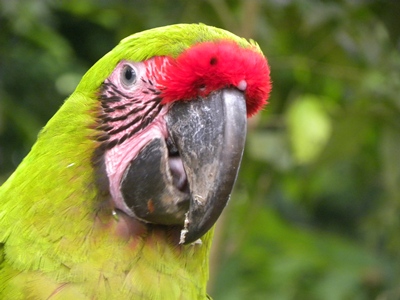
Great Green MacawMaquenque is a place for bird-watching. Lodge information cites more than 410 identified species of birds in the area, including endangered Great Green Macaws (Ara ambiguus) and Scarlet Macaws (Ara macao). With only a few thousand Great Green Macaws left in the world, it is an exceptional treat to see these spectacular green and turquoise parrots with their distinctive fiery red band across their foreheads.

Canoeing on the lagoon at Maquenque LodgeBesides bird-watching, you can canoe on the lagoon, hike in the rainforest, ride horses, go boating on the San Carlos River, and float river rafting on the Tres Amigos River. The climate is very rainy, so be prepared.

Maquenque Eco-Lodge supports sustainable tourism and reforestation. Every guest who stays has the chance to plant a tree in the reserve and visit the local school to see their environmental education program in action.

Article by Shannon Farley